Monday, June 6, 2016

God Told Me to Skin You Alive


God left us to die here
With no proof of his existence
We're subjects trapped in a world of objects
With no knowledge of how we got here

All we can figure out about ourselves: On a planet surrounding a dying star, relatively hairless bipedal former apes who perceive three dimensions of space and one of time, largely unaware of the causes of things.


"Poem" by me, Nicholas Anderson. Above collage by Winston Smith, used as cover art of Green Day's 1995 album Insomniac. 

The Typewriter is Holy: Retrospective on the Beat Generation


This really is the uncensored and complete story. The book is full of interesting stories and little moments which give a very personal understanding of the members of the "beat generation." One story that in particular caught my interest is the account of Lucien Carr biting off glass from his beer bottle; bleeding badly he challenges the others to do the same, and Burroughs enters the room with a try of razor blades and light bulbs as "hor d'ouevres." 


The book's theme is that the beat movement should be seen as an extensive social group with Allen Ginsberg at the center bringing and keeping everybody together. Whether this is totally accurate (this is the first history of the movement I've read) isn't really important. The thesis gives a nice structure to the work and is credible enough. What defines the Beat Generation is a general attitude of life; adults coming of age in the World War Two and post-war years feeling a lack of authenticity and spirituality in American society, who welcomed and experimented with alternative and low life ways of living as personal inspiration. The beats were as intellectual as they were sensual, an aspect overlooked by contemporaries be they reactionaries or hippie baby boomers. 

As for the name the beat generation, it was coined by Jack Kerouac who first heard it from small time thief Herbert Huncke describing the beaten down feeling of the post war conformist culture as well as the spontaneous feeling of jazz music which inspired their work. John Clellon Holmes, whose 1953 book Go is the first beat novel, got to describe the generation to readers in the New York Times and brought the term to public consciousness. And as for the name of this book, it's from a footnote in Howl: "The typewriter is holy the poem is holy the voice is holy the hearers are holy the ecstasy is holy!"


The beginning of the beat generation was a chance encounter between college students Allen Ginsberg, a New Jersey native, and Jack Kerouac, from Lowell Massachusetts, at Columbia university during World War II when Allen heard music coming out of Jack's room at the residence halls and decided to visit him. Ginsberg and Kerouac, who was there on a football scholarship, got to know another classmate Lucien Carr and through him David Kammerer, an older homosexual admirer, and through Kammerer William Burroughs, heir to inventor of an adding machine, became part of the group. Burroughs, Carr, and Kammerer's all previously lived in St. Louis Missouri; Kammerer followed Carr to New York and so did Burroughs. Through yet another Columbia student, Hal Chase, Ginsberg and Kerouac got to know Neal Cassady with whom they would make their famous cross country travels. By hanging out with these individuals, the inhibited Allen and Jack got inspiration for their work as well as the ability to transgress social boundaries. This is when the lore of the generation begins, with a story of murder figuring in at the beginning. Kammerer's sexual advances on Carr who was straight weren't welcome and when David tried to follow Lucien on a trip overseas, Lucien stabbed David and threw his body into the water. Kerouac and Burroughs would collaborate on a book about the event, And The Hippos Were Boiled in Their Pots which was published only recently, named after a radio report they heard about a zoo fire. Carr got off pretty easily as back then murdering a homosexual wasn't much of an offense, so he literally got away with murder. 

Allen and Burroughs got involved with criminals and criminality through Herbert Huncke, the king of 42nd st, which furthers the story. Herbert was living with Allen and started stashing stolen items there. In 1949 Ginsberg was caught in a police chase in a car with stolen goods and escaped after the car crashed, but was incriminated by the writings left behind. He escaped hard time by pleading insanity and become institutionalized. While institutionalized Allen met Carl Solomon who introduced surrealism to him. Solomon himself was institutionalized for his erratic behavior which was at least partly aesthetic, like throwing potato salad at a lecturer on Dadaism. Solomon actually demanded a lobotomy be performed on him. Allen was so influenced by Carl that he dedicated his famous poem Howl to the man. 

Burroughs sold morphine syringes to Herbert, who thought Bill was FBI due to his attire, an account retold in Burroughs' first novel Junkie. Bill would move to Texas with his common law wife Joan Robinson to try his hand at farming hemp, and then sell it as marijuana. 

While staying in Mexico in the early fifties Burroughs killed his wife Joan. While drinking Joan put a glass on top of her head and dared Bill to shoot it off, like the legend of William Tell. Burroughs was usually a good shot, but he missed and killed Joan. Burroughs left Mexico, was tried in absentia, and for nearly two decades didn't live in the US for any protracted period of time; not coming back permanently until 1974. By then the US changed and was becoming more open to alternative lifestyles, but I suspect it really was Joan's death. He did say that Joan's death made him become a writer. Much of Naked Lunch is inspired by his travels in South America and his time in Tangiers.

The rest of the beat story is mostly geographical. Living and typewriting in Mexico City, Kerouac making his famous travels with Neal Cassady to the west coast, meeting European intellectuals like Duchamp and Celine in Paris at the "beat hotel", Burroughs spending two decades living outside the United States in Europe and Tangier Morocco, and very significantly setting up a west coast cultural movement in San Francisco, making ties to the burgeoning counter culture. Ginsberg moved to San Francisco after failing to rekindle a romance with Cassady in California, his wife didn't approve of it. It was there that Allen gave an important public reading of Howl at the Six Gallery 1955 which was met with great enthusiasm. 

Notoriety of their writing built up slowly over the 1950s. In San Francisco the city lights bookstore run by Lawrence Ferlinghetti published their work in pocket editions and contact was made between the west coast counterculture there with the beats who originated in New York City, along with the so-called subterraneans of Greenwich Village, where a folk music movement would latter blossom. Kerouac's On the Road got a positive review in the New York Times when it finally came out and he was dubbed the voice of a generation. The two high profile censorship court cases of Howl and Naked Lunch also boosted their public profile. It was in San Francisco and the city light bookstore that Ginsberg poem ran into legal trouble, peddling profanity. The judge sided with Ginsberg and the ACLU and accepted the artistic merits of the work. The case also led to an end of censorship of other controversial works Tropic of Cancer and Lady Chatterley's Lover. Naked Lunch was banned in Boston in 1962 which was reversed by the state Supreme Court in 1966. After this decision outright censorship, like the destruction of Wilhelm Reich's books, would become a thing of the past. 

Most people who know of the beats know only of the big three: Allen Ginsberg, Jack Kerouac, and William S Burroughs and their well known respective works Howl, On the Road, and Naked Lunch. But there were many others important to the movement and who influenced or appeared in their work. Most prominently Neal Cassady who appears as Dean Moriarty in On the Road, and who inspired the spontaneous free writing style used in the book, in a letter sent to Jack describing his sexual conquests. Other important figures besides those I've mentioned were Gregory Corso, Lawrence Ferlinghetti, one of the few African Americans Leroi Jones, Diana Di Prima, Ginsberg's lifetime partner later in life Peter Orlovsky, Gary Snider etc. The largely white and male status of the generation is discussed by Morgan in a critical though contextual light. The generation was throughly progressive in its acceptance and practice for many of homosexuality.  Ginsberg, Burroughs, and Kammerer were homosexual and Cassady slept with men from time to time. Their writings are the first and most honest portrayals of homosexuality in American literature, and so the pc crowd can get over some of their sins. 

It is still useful to view the history of the beat generation through the three personalities of Ginsberg, Kerouac, and Burroughs. Ginsberg was the communicator and movement builder of the group, making important relationships with the likes of Bob Dylan. Ginsberg came up in the age not only of repression of homosexuality, but active efforts to reform non hetero behavior through the medical establishment. He actually convinced himself that his homosexuality was a sign of mental insanity, which had taken over his mother. Ginsberg went through psychotherapy which actually convinced him to date women and be straight. Incidentally his mother went through psychiatric surgery, which Ginsberg agreed to with great regret, which turned her into a vegetable. Ginsberg of the three was shy and inhibited, as was Jack, but also it seems the most congenial and ecumenical. His curiosity, desire to experiment, and just to be with people like himself helped to link the people in the book together. Also as mentioned once in the book Allen sort of took on the persona of his Jewish mother, protective and understanding. 

Jack Kerouac is a tragic case. Shy and inhibited like Ginsberg, he was also fairly conservative. Though the heterosexual of the trio, he was married thrice and avoided child payments for the rest of his life, denying paternity. Of the three he is the intellectual spokesman of the generation, who articulated its principles and aimed the most to be a traditional writer. He had a knack of coming up with titles and phrases, "he took life in the raw" is how he describes Dean Moriarty in On the Road. Kerouac really just wanted to be a respected American writer like Thomas Wolfe. Though now recognized as one of the great American novelists by many, in his lifetime he and his writings were the subject of criticism and ridicule. He didn't like the counterculture and distanced himself from the outside world. An important reason for this was his strong attachment to his mother Gabrielle; if Jack never let go of the apron strings he would never get to be his own man. As she aged Jack spent more time and moved in with her, probably something to do with his French Canadian heritage. What did Jack in was his drinking problem, which led to his death and unlikable public persona. He made a serious attempt to kick his habit, recounted in one of his last books Big Sur in the Sierras, but wasn't successful. Kerouac died before reaching 50, in 1969, to be outlived by Ginsberg and Burroughs who lived to the 1990s. Recently, as in twenty first century, there has been "new" material from and about Kerouac such as the 2007 publication of the original taped together scroll manuscript of On the Road, the 2008 publication of the Burroughs collaboration And the Hippos Were Boiled in Their Pots mentioned earlier, as well as the 2012 movie adaptation of On the Road directed by Walter Salles, which is okay (don't watch before reading the book). So he lives on.

Burroughs is portrayed as aloof and intellectually eccentric, despite having a deadpan demeanor and dressing in a g-man suit. The oldest of the group he was also the most revolutionary artistically. He along with Brion Gysin pioneered the cut up method: take a page and cut it down the middle and place the halves with halves of other pages to make something completely. This method can open up new ways of reading texts and he claimed see into the future. Much of Burroughs' work enters the realms of fantasy, science fiction, and even horror. There is a dark humor to his writing and along with the anti realism would go on to influence postmodern literature. Burroughs is the one who's influence extends beyond the 1960s to the punk/alternative subcultures, being an inspiration to Ian Curtis of Joy Division and even collaborating with Kurt Cobain before Nirvana went big. Bill even appears in the music video Just One Fix by industrial band Ministry. Director David Cronenberg was heavily influenced by Burroughs with his postmodern horror vision, and even directed a film adaptation of Naked Lunch in 1991 which is also biographical. Burroughs really outlived the beat generation and the 60s counterculture which he didn't like and anticipated the new cultural and youth movements of the late 20th century. 

If Ginsberg is the Jewish mother, Kerouac is the wayward son and Burroughs is the perverted uncle. In terms of their political views Ginsberg was the liberal activist most sympathetic to socialism, Kerouac was conservative, and Burroughs a libertarian maybe leaning to the right. 

Of great interest is the connection between the beats and the 60s counterculture. Cassady was the driver of Ken Kesey and the Merry Pranksters' acid trip, recounted in the book The Electric Cool Aid Acid Test. Huncke and Burroughs participated in the 1948 Dr. Alfred Kinsey sexual study of the American male which presaged the sexual revolution. Allen partook along with Kesey in the mk-ultra program, the CIA program which tested LSD. Timothy Leary also associated with the beats but his drug advocacy was not as intellectual as theirs was. Burroughs traveled South America looking for powerful hallucinogenic drugs to inspire his writing. 

The beats were the beginning of the American counter culture all the way back in the 1940s, chiefly in Greenwich Village and San Francisco where later movements grew out of. Kerouac himself claimed that the actual movement ended by the early 50s, whereas in the popular mind beatniks went all the way up to the 1960s, reading poetry to jazz music and wearing all black turtlenecks and sun glasses, playing bongos and smoking cigarettes. When you consider the generation as a social group around Allen Ginsberg, then the generation extends from the 1940s to the 1970s, as this book recounts. 

The beats hold a special place in history. They exist as an example unto only themselves and those who care to listen. They were against the controlling conformist world they came into and were misunderstood by the later counterculture which didn't care for the intellectual and reflective side. I think they exemplified what Americans should be, proud individualists who dare to explore new things, no matter how seemingly strange or dangerous. Their goal was to expand human consciousness into both the lewd and obscene as well as the intellectual and spiritual. The entire capability of human experience, which most movements and cultures throughout history seek to limit to fulfill their agenda. It reminds me of what John Stuart Mill said in response to the simple utilitarian criteria of all pleasures being equal: "it is better to be Socrates dissatisfied than a pig satisfied." While typing away manuscripts their raucous exploits could be given the careful treatment of conscious reflection to cull something greater than the sum of disparate events, and communicate this to willing readers. If you want to understand the members of the beat generation, you have to read and think as well as "be" and "feel". I don't expect you to understand. 

I got interested in the beats back in High School. My interest was consummated when I first read On the Road the summer of my senior year. Around the same time I was fascinated with the book and movie Into the Wild which is about Christopher McCandless' own cross country journey and rejection of the life expected of him. Towards the end of high school I came across a copy of Naked Lunch in a name-your-price bookstore downtown which sold old playboys with a nobody under 18 label. I later befriended a neighbor who I didn't know existed not far from my street who had a little collection of beatnik literature, which is where I read Howl while house sitting. My interest in Kurt Cobain and the music along with the reading Jon Savage's history of the Sex Pistols England's Dreaming in middle school was what convinced me that the ethos of the American counter culture was how I should model my own life. Nothing has pleased me like making connections between the individuals who have have influenced and interested me. Jim Morrison also read On the Road at a formative age. It's the people who expressed themselves in the way they conducted their lives which becomes handed down to posterity who make life something to be treasured. For me it begins historically with beats, like when John Lennon said that before Elvis there was nothing.

Sunday, May 29, 2016

We Come From the Water

We come from the water. Our common ancestors from millions of years ago are shared with ocean dwellers today. Land animals only emerged 350 million years ago during the late Devonian period, the age of the fishes. Life itself began in the water, either in the oceans or in pools of water. In either case water containing amino acids is what the first single cellular organisms developed from. The first cities were founded by the water, and our great cities today are by bodies of water. Egypt grew around the Nile, Mesopotamia around the Tigris and Euphrates rivers.

The first philosopher/scientist Thales thought that water was the fundamental element of the universe.

"Thales, the founder of this kind of philosophy, says that it is water (that is why he declares the earth rests on water). He perhaps came to acquire this belief from seeing that the nourishment of everything is moist and that heat itself comes from this and lives by this (for that which anything comes into being is its first principle)- he came to his belief both for this reason and because the seeds of everything have a moist nature, and water is the natural principle of moist things." Aristotle-Metaphysics

Another pre-Socratic philosopher Anaximander is supposed to have said that humans originally developed inside the bodies of fish until they were able to look after themselves. This is symbolic both of the long time it takes for humans to mature as well as our oceanic ancestry. Since society developed near the water, before humans could develop their own industry and figure out ways to irrigate we were dependent on bodies of water.

"Animals come into being <from moisture> evaporated from the sun. Humans originally resembled another type of animal, namely fish." Hippolytus-Refutation of all Heresies

"Further, he says that originally humans were born from animals of a different kind, became the other animals can soon look after themselves while humans alone require a long period of nursing; that is why if they had been like this originally they would not have survived." Plutarch-Miscellanies

"Anaximander of Miletus says he thinks that from hot water and earth there arouse fish, or animals very like fish, that humans grew inside them, and that the embryos were retained inside up to puberty whereupon fish like animals burst and men and women emerged already able to look after themselves." Censorinus- On Birthdays

"The descendants of old Hellen actually sacrifice to Poseidon the Ancestor, believing that men grew from the moist substance, as do the Syrians. That is why they revere fish, as being of the same species and the same nurture as themselves. Here their philosophy is better than that of Anaximander. For he says, not that fish and men were born in the same surroundings, but that at first men came into being inside fish and were nourished there-like Sharks- only emerging and taking to land when they were able to look after themselves. So just as fire consumes the matter from which it was kindled (it's own mother and father, as the poet who inserted the marriage of Ceyx and Hesiod's poems said), so Anaximander, having declared that fish are at once fathers and mothers of men, urges us not to eat them." Plutarch-Table Talk

There's a similar "theory" out there today for our direct origins from the water. The heterodox "aquatic ape" hypothesis argues that homo sapiens evolved the physiological features different from other primates like lack of body hair and subcutaneous fat because our ancestors spent some of their lives in the water. There isn't much proof for this and it is a minority position. I first heard of it from the Mermaids: The Body Found mocumentary from the Discovery Channel when to my surprise I learned it was an actual hypothesis. The aquatic ape hypothesis does keep our aqueous heritage on the mind. 

Looking to mythology, the Babylonians supposedly learned the arts of civilization from an amphibious fish-man hybrid named Oannes, also known as Adapa a Promethean figure, who came from the ocean. Oannes is probably the fish-God Dagon who was worshiped by Semitic peoples: the Babylonians, the Philistines, and the Phoenicians. The temple Samson destroyed in the Old Testament was a Philistine temple to Dagon. The name Dagon means something like grain, referring to agriculture, knowledge of which is what inaugurated humans into civilization. 

"At first they led a somewhat wretched existence and lived without rule after the manner of beasts.

But, in the first year after the flood appeared an animal endowed with human reason, named Oannes, who rose from out of the Erythian Sea, at the point where it borders Babylonia. He had the whole body of a fish, but above his fish's head he had another head which was that of a man, and human feet emerged from beneath his fish's tail.

He had a human voice, and an image of him is preserved unto this day.

He passed the day in the midst of men without taking food; he taught them the use of letters, sciences and arts of all kinds. He taught them to construct cities, to found temples, to compile laws, and explained to them the principles of geometrical knowledge.

He made them distinguish the seeds of the earth, and showed them how to collect the fruits; in short he instructed them in everything which could tend to soften human manners and humanize their laws.

From that time nothing material has been added by way of improvement to his instructions.

And when the sun set, this being Oannes, retired again into the sea, for he was amphibious."


Oannes/Dagon is related or identical to the Sumerian God Ea/Enki, as well as Poseidon/Neptune of the Greeks and Romans. Enki was the patron god of man and resided in the first city Eridu. His temple was underwater, and he was described as half-man half-fish, like Oannes. Enki saved life on Earth from the great flood by warning Altrahasis (Utnapishtim in The Epic of Gilgamesh) in a dream and orders him to build a ship like Noah's Ark. 

There is a possible parallel between Dagon and the Egyptian god Osiris. Osiris was castrated and dismembered by his brother Set. Osiris's wife Isis recovered his body parts and brought him back to life, but didn't find his penis. His phallus was swallowed by a fish in the Nile. This fish supposedly became Dagon. 

The name Dagon and the description of him as amphibian teacher to humans, Oannes, may be related to the Dogon people of Mali, Africa. The tribe has a great knowledge of astronomy, claiming their gods come from the distant star Sirius, implying they had contact with or descended from an advanced civilization in their past like Egypt (or maybe aliens...). The Dogon worship ancestral spirits named the Nommo, which means "to make one drink." The Nommo are amphibious creatures with a humanoid upper body and legs with a fish torso and tail. The Nommo are the ones who taught the Dogon people astronomy, among other things. 

I and many people I suspect learned of Dagon and his status as a water god from HP Lovecraft's 1917 short story Dagon. In Dagon, the narrator is drifting in the Pacific ocean on a lifeboat after his ship is captured by German during World War I. The water south of the equator becomes black and thick enough to walk enough, supposedly what used to be the ocean floor has risen to the surface. Upon descending a mound he encounters a stone monolith covered with hieroglyphics of sea creatures, and disturbing amphibious humanoid creatures:

"I think that these things were supposed to depict men—at least, a certain sort of men; though the creatures were shown disporting like fishes in the waters of some marine grotto, or paying homage at some monolithic shrine which appeared to be under the waves as well... They were damnably human in general outline despite webbed hands and feet, shockingly wide and flabby lips, glassy, bulging eyes, and other features less pleasant to recall. Curiously enough, they seemed to have been chiseled badly out of proportion with their scenic background; for one of the creatures was shown in the act of killing a whale represented as but little larger than himself."

After encountering the monolith, a monster emerges from the water . In an attempt to alleviate his traumatic experience the narrator seeks the same mythology mentioned earlier. "Once I sought out a celebrated ethnologist, and amused him with peculiar questions regarding the ancient Philistine legend of Dagon, the Fish-God; but soon perceiving that he was hopelessly conventional, I did not press my inquiries." There's no consolation from the remnants of ancient history for him.

The shrine beneath the waves is that of Cthulhu, who like Enki/Ea had a palace under water. In the later story The Shadow Over Innsmouth 1931 the fish men are referred to as "the deep ones." The New England town of Innsmouth came into contact with the deep ones who a merchant Obed Marsh learned of from a tribe in the West Indies. The town was in economic trouble, and so Obed and his followers summoned the deep ones to increase their wealth. They build a church, the Esoteric Order of Dagon and offer human sacrifices and women to mate with the amphibious creatures. The offspring are born normal looking humans, but grow up to be fish-men and join the old ones in their cities underground. The US government shuts all of this down, arresting large numbers of people and destroys buildings, under the guise of enforcing prohibition. 

I was quite pleased to find out that Lovecraft based a lot of this on old Mesopotamian mythology. Many of his stories are about the unearthing of the inhuman origins of humanity which have been hidden away, to protect us from an inimical and indifferent universe. The further back one goes in human history, the closer one gets to the truth. 

It is with the rise of the Abrahamic religions begins the end of the water gods' hold over western culture.

1 Samuel 5.2-7
After the Philistines had captured the ark of God, they took it from Ebenezer to Ashdod.
2 Then they carried the ark into Dagon's temple and set it beside Dagon.
3 When the people of Ashdod rose early the next day, there was Dagon, fallen on his face on the ground before the ark of the LORD! They took Dagon and put him back in his place.
4 But the following morning when they rose, there was Dagon, fallen on his face on the ground before the ark of the LORD! His head and hands had been broken off and were lying on the threshold; only his body remained.
5 That is why to this day neither the priests of Dagon nor any others who enter Dagon's temple at Ashdod step on the threshold.


The literal falling of Dagon before the ark is symbolic of the eclipse of paganism and the rise of Abrahamic monotheism. The God of Abraham does not subsist in and is not born of the primordial waters like the old gods.

Enuma Elish, Babylonian creation epic:
"When on high the heaven had not been named, firm ground below had not been called by name, naught but primordial Apsu, their begetter, and Mummu Tiamat, she bore them all, their waters commingling as in a single body: no reed hut had been matter, no marshland had appeared, when no gods whatever had been brought into being, uncalled by names, their destinies undetermined-then it was that the gods were formed within them."

For the Abrahamic religions, the waters are divided by a firmament. God separates the heavens from the earth from the very beginning. The western pagan religions have it that the gods themselves are born of the primordial waters, matter precedes the gods. In Hesiod's theogony of the Greek gods the chasm or chaos is primary, less materialist and more "philosophical"; a transition to the religion of the Word.

Genesis
"Then God said, “Let there be a firmament in the midst of the waters, and let it divide the waters from the waters.” Thus God made the firmament, and divided the waters which were under the firmament from the waters which were above the firmament; and it was so. And God called the firmament Heaven. So the evening and the morning were the second day."

Notice God says and it is done, the word determining material reality. The conscious fulfillment of a wish.

As western society has progressed, we have moved away from worship of our origins in the water. Yet some say that the pope's current hat, the mitre, has its origins in the worship of Dagon the fish god. The opening of the mitre is a fish mouth! The high priests of Babylon it is said wore fish head hats and robes which resembled fish bodies. An alternative explanation is that of Jesus saying the apostles are to be fishers of men, which already sounds fishy. Perhaps the design is unconscious, a product of the Church originating in a pagan world.


Looking to the esoteric, the Pythagorean cult can give us symbolic meaning to our aqueous origins.

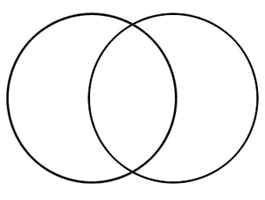
The first thing in existence was the monad, a single circle, self contained like the single cell, the life in the water or the embryo in the fluids of the womb. Then comes the dyad when one becomes two, though still linked together. The shape created by the two circles is the vesica piscis, the fish bladder; the physical origin of separateness from the mother, duality. The vesica piscis is the vagina, the passage of birth and also the urethra of the penis, from which fermenting semen comes. Also it is the fish symbol Christians use, the ichthys. The separation of life from the ocean for the first land dwellers is a symbolic recapitulation of the original separation. 

As millions of years pass, our aqueous ancestry is pushed back further into our physical development. The mammal fetus has gill pouches early on just like the fish, though these don't develop into functional gills and serve other functions. Western religion goes on to separates man from the waters early on, though still retaining aspects. Through irrigation we are able to have sedentary civilization further away from the source of water and see our labor and ingenuity as the fountainhead of civilized life. 

The human race's separation from the water is like the tale of Odysseus in Homer's Odyssey. Odysseus's perilous journey home is so because of the antagonism of the god Poseidon, who is angry at Odysseus for killing the cyclops, his son. It is Poseidon who makes Odysseus' return home so long, the sublime power of the oceans which still have the capacity to overwhelm us. Most of the depths of the ocean are undiscovered and the surface of Earth is mostly ocean and sea. When we look for signs of life on other planets, we look for water. 

Thomas Hobbes' 1651 political treatise Leviathan uses the eponymous sea monster of the Hebrew bible as a metaphor for the political sovereign. The human ruler instills fear and the sense of greatness in followers by common consent to total coercive authority which replaces the terror of nature and God in providing order. Ancient societies declared their rulers as gods, giving special authority to their reign. Up to Hobbes' time Christian, rather than polytheist, absolute monarchists defended the divine right of kings, descended from Adam, to justify the sovereign's authority as higher than worldly performance. Hobbes applied the principles of the burgeoning scientific revolution, namely the law of inertia, to human nature and inaugurated a new form of political justification; the will of the people. Since humans are just matter conserving their state of motion like anything else in the universe, social order isn't natural but artificial. Society only works by external restraint on people's bodily motion which left alone will continue to the possible detriment of others. Before Galileo it was thought that a body required continual force to be in motion, a first mover, but if an object in motion conserves its state of motion then the threat of force isn't enough. It is the uncertainty of the state of nature in which there are no physical restraints on what people can do which requires humans to make their own leviathan. Only by common consent to a common power are we able to instill the fear that any individual will be prevented from breaking the law. 

This is the beginning of modern political thought; human political order as our own creation, understood with the same principles that govern the physical universe. No gods or first movers are required, every individual can understand why we have the law with their own reason and participate in the making of the law with the advent of liberal democracy. We have become the leviathan. A retracing of our evolutionary history and the beginnings of western religion can reveal our origins and hopefully give us a renewed understanding of our relationship to the water, our first home. 

Wednesday, May 25, 2016

The Meaning of Existence

The achievement of pleasure and the absence of pain both lead to boredom. Both pain and pleasure are quantitative disturbances of chemical equilibrium. Hope and fear both emerge from an inherent realization of the dominance of equilibrium, of a certain biological constancy. We hope for pain to end and return to us to a previous satisfactory state or perhaps payoff for a different but similarly constant state. We fear loss of what gives us pleasure or increase of what causes more pain, desiring a return to equilibrium.

The subjective qualities of pleasure and pain differ, but each are an excess of energy of a certain time and duration which cannot last. Our demand is an energy demand on the mind to work and so has a somatic origin. Emotions as the word suggests put us in a state of motion, for they ultimately share the same purpose. All irritation.

The purpose of all life is death. From nothing to nothing. The unliving outnumber the living in the universe.

In Spanish what is fun or amusing is divertido, a diversion, as my sophomore Spanish teacher told me. Passion from Latin "pasus" means to suffer. A passion for life, for anything, entails suffering.

The state of indifference characterizes us for more of our existence than pleasure or pain.

We spend much of our lives asleep, largely indifferent to the outside world. Our days are intermittently interrupted by day dreams where we are consciously indifferent to our immediate environment. One becomes lost when reading an engaging novel or envelopes while watching television or film.

Hypnotism, meditation, and the placebo effect demonstrate the great power the mind has to be indifferent to certain stimuli and simulate reality. Our mental state can be altered by intense focus, because of suggestion by ourselves or others, without the somatic effect of external stimuli. 

Our brains can't possibly process all the information of our senses, electrical activity in the brain occurs before we are conscious. To imagine is to think less than we perceive. To be actively indifferent to stimuli. The mind didn't evolve to mirror reality but to serve the promulgation of the species. Man never realizes how anthropomorphic he is, as Goethe said.

Freedom of the will consists in doing what we will do unimpeded externally and the conscious functions in agreement or ignorance with the act. As per Schopenhauer; man can do what he wills, but he cannot will what he wills. What bodies do is different than what the mind commands, they do what they do. We're just lucky that we either are unaware of the physical causes of our actions or are in conscious harmony with them.

The meaning of life is found in the act, that which sustains and enhances our own lives. Anatomical change comes about as a consequence of behavioral change. "Birds do not fly because they have wings; they have wings because they fly"-Robert Ardrey.

Life escapes meaning outside of our individual activity, but we are able to spend much of it in complete indifference to this reality. It is only in our waking moments of self-reflection that the meaning of life has any significance. But we create this problem for ourselves, for demanding meaning from existence is to view existence as something alien and itself in demand of justification, to treat being as an individual thing to be analyzed. We make the meaninglessness of life a problem because we demanded justification in the first place.

Sunday, May 22, 2016

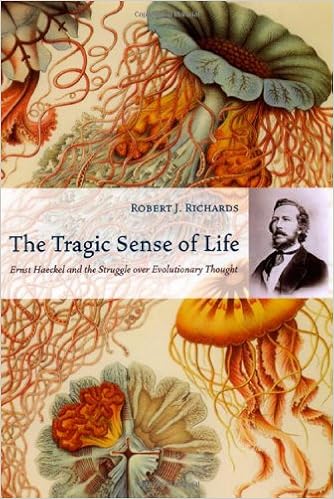
The Tragic Sense of Ernst Haeckel

The tragic sense of life for Haeckel is also the romantic conception of life, the title of another book by Richards. The thesis of the Tragic Sense is that the biologist Ernst Haeckel shaped the public reception of evolutionary theory after Darwin more than anybody else into an anti-religious and monistic worldview because of his intellectual upbringing with the works of German romantic era writers Johann Von Goethe and Alexander Humboldt and the death of his first wife Anna which made Haeckel more militant in his views.

Haeckel is not as well known in the twenty first century. In the late 19th century his books were more popular than Darwin, as he more than anybody is the source of evolutionary thought in public consciousness. His biogenetic law, "ontogeny recapitulates phylogeny", that the development of the embryo repeats past stages of evolutionary ancestry, is still widely known and for those who accept evolution still widely believed. The early embryo has gill pouches which developed into gills for our fish ancestors, has a reptilian circulatory system, and has a fine coat of hair the lanugo like mammals which is shed before birth. Those who know who Haeckel is and are familiar with current biology know that Haeckel is a controversial figure and that Haeckel's specific law of recapitulation is considered a special case of embryonic development and not all encompassing evidence of our evolutionary lineage. Neotenous traits, youthful traits of our ancestors carried into adulthood, seem to be the opposite of recapitulation or at least Haeckel's specific version of it. The axolotl fish for example. Still even the counter examples demonstrate a profound parallel between ontogeny and phylogeny which only cuts against the specific recapitulation of adult ancestral traits. It makes sense that more primitive and shared traits with other species develop earlier in the individual in truncated form than later species specific traits. Creationists and Darwinian opponents claim Haeckel forged his famous embryo drawings between humans and different animals to make them appear more similar. Richards deals with this handily in the book and even wrote a separate article on the issue in which if the yolk sac is removed the fetuses do look similar.

Haeckel is also associated by some with Nazi evolutionary racist theories as he applied evolutionary thinking to race, even though he died in 1919 over a decade before anybody knew about the Nazis. Richards combats such claims by pointing out the association between evolutionary thinking and radical liberal/socialist movements in the 19th century, as well as Haeckel's own attitude towards Jewish people. Indeed Haeckel's legacy is because he so readily applied evolutionary thinking to every aspect of life. Haeckel meant his work for a wide audience, particularly his Riddle of the Universe 1899 (Welträthsel in German). I've read some of the book which can be found online and the monistic conception of evolution he holds goes beyond Darwin's theories. Haeckel puts Goethe and Lamarck along with Darwin as evolutionary theorists and bases his conception of the world on the law of substance, basically the conservation of matter and energy. The message of the book is revolutionary, as he notes that science had advanced much up to the late nineteenth century but old institutions like state and religion had not. The work as well as Haeckel's own religious thought is pantheistic in tone, much like that of Herbert Spencer's. Haeckel is a sort of culmination of the Spinozist influence on German thought since Goethe updated with then current scientific theory.

It says more about the state of Europe since the turn of the century that a thinker such as Haeckel would cease to be progressive and become in the eyes of many a reactionary. Critics of recapitulation claim the theory is inherently progressive and racist in its view of human nature since humans in different environments will continually diverge and push back common ancestral traits earlier in life, forming different races. Some would claim there is an element of Lamarckian inheritance if natural selection can only act on later stages, which appear during our active waking life. But Darwin and other evolutionists at the time had these elements when the theory was at its beginning. The scientific spirit of inquiry improves on such foundations. 

Recapitulation is important because it explains the apparent design of life. Critics of evolution claim that random variation cannot account for the variety and complexity of life. A room full of monkeys with typewriters would take forever to recreate the works of Shakespeare, even though it isn't impossible, just very unlikely. But imagine if every word or sentence which was correct was selected for the monkeys to begin working on, the "correct" parts being retained for future generations to work from, only changed by genetic selection of mutations. Evolution doesn't happen from scratch from random variations. Our common ancestry means we're all working from the same beginning, changing according to our environments but retaining traits which aren't selected against genetically. These vestigial traits as they're called, goose bumps and tail bone for example, are our true mammalian ancestry which becomes "falsified" by natural selection acting on our species. The parallel of individual with species development allows for a greater interconnection with nature than just natural selection on populations. The archetypal patterns of nature, first worked out in detail by Goethe and Humboldt, can be embraced without intelligent design. The romantic conception of life is infused into scientific materialism. Haeckel's collection of drawings Art Forms in Nature demonstrates the "design" in nature, featuring radiolaria skeletons. The skeletons are what are preserved after the organism dies and the design is repeated in more complicated organisms. A very helpful visual analogue to understand the naturalist appreciation of design and beauty in nature. Everything builds off the design what came before. 

The Anna angle doesn't figure too much in the book which is a comprehensive history of the man and his influence/critics rather than a biography. I haven't read The Tragic Sense of Life by Miguel de Unamuno which this book is named after, though I surmise it's about preoccupation with death or other existentialist themes. The death of Anna brought Haeckel a tragic sense of life as she was an intellectual as well as romantic partner. Haeckel's militant monistic presentation of evolution was his way of transcending death and connecting man with the universe. I'll have to read Unamuno to understand this more fully. 

I was a bit disappointed that Haeckel's later influence on individuals wasn't more fleshed out. HP Lovecraft, an ardent materialist, mentions Haeckel by name in Herbert West: Reanimator. "Holding with Haeckel that all life is a chemical and physical process, and that the so-called “soul” is a myth, my friend believed that artificial reanimation of the dead can depend only on the condition of the tissues; and that unless actual decomposition has set in, a corpse fully equipped with organs may with suitable measures be set going again in the peculiar fashion known as life." Haeckel's recapitulation also had a significant influence on early psychoanalysis, which Stephen Gould discusses in Ontogeny and Phylogeny (1977) as does Frank Sulloway in Freud: Biologist of the Mind (1977). Freud invokes the biogenetic law in the preface to Three Essays on the Theory of Sexuality (1905). "Ontogenesis may be considered as a repetition of phylogenesis insofar as the latter has not been varied by a more recent experience." Hungarian analyst Sandor Ferenczi in Thalassa: a Theory of Genitalia (1924) extended recapitulation to the development of the womb itself, arguing that our life in the womb as embryos is reliving our evolutionary ancestry in the oceans! Haeckel has had a larger influence than perhaps Richards discusses in this book by the implicit acceptance of his theories into the twentieth century. Another gripe is the little discussion of his well known Art Forms in Nature, the beautiful collection of illustrations for which he is still known for by non-scientists, though the copy I have has an introduction to suffice. This work is best read with the context of Roberts' previous work and Unamuno. Luckily the book reads very well and can be finished quickly. Good writing.

Tuesday, May 17, 2016

Thalassa: The Origin of Mammalian Existence from the Ocean

In Thalassa: a Theory of Genitalia (1924) Hungarian psychoanalyst Sandor Ferenczi connects ontogeny with phylogeny: individual development, a la Freud's Three Essays on the Theory of Sexuality (1905), with evolutionary history. The book reads like a collection of essays or lectures with the somewhat misleading title Thalassa. Thalassa was a mythological spirit of the sea from whom fish come from, so from the title I was expecting only an explication of the parallel between our ancestral lineage from the ocean with our life in the womb. The original title in Hungarian is actually "Catastrophes in the Development of the Genital Function: A Psychoanalytic Study." I learned of this work from Stephen Gould's Ontogeny and Phylogeny (1977) where he devotes a chapter tracing the influence of Ernst Haeckel's recapitulation theory to psychoanalytic thought. Instead the book really is mostly a theory of genitalia. Thalassa and the mythology around her isn't discussed at all, so Ferenczi assumes you know all that. The parallel itself is discussed in full in the chapter The Phylogenetic Parallel and in the final chapter. The rest of the book speculates on genital development, as linked to the anus (like it is with the cloaca of birds and reptiles) and coitus itself as a symbolic return to conditions of the womb. 

Ferenczi uses an evolutionary theory built on Lamarckian inheritance, non-genetic acquired characteristics, and Haeckel's recapitulation, the development of the embryo parallels the development of evolutionary ancestry. Ferenczi explicitly rejects a Darwinian mechanism of natural selection to argue for the development of placenta. The placenta in which mammal embryos live in he argues is a remnant of the aquatic ancestry of all land mammals who had to develop new ways to develop offspring rather than soft eggs in the water. Reptiles and later birds evolved hard eggs, and mammals evolved live birth where development occurs inside the mother. Life in the egg or the womb which the embryo lives in is like the ocean, surrounded by life sustaining fluids. The disappearance of oceans and appearance of land are akin to the trauma of birth where animals at the end of the Devonian period had to develop new ways to breathe for themselves, much as babies do after birth. A greater dependence on the mother is the solution mammals came up with, receiving vital fluids from the mother and forming a closer emotional bond. 

"For, we reflected, what if the entire interuterine existence of the higher mammals were only a replica of the type of existence which characterized that aboriginal piscine period, and birth itself nothing but a recapitulation on the part of the individual of the great catastrophe which at the time of the recession of the ocean forced so many animals, and certainly our own animal ancestors, to adapt themselves to a land existence, above all to renounce gill breathing and provide themselves with organs for the respiration of air?" 

I first read in HG Wells' A Short History of the World (1922) that our mammalian nature of caring for our young is the beginning of our social life, so there is a phylogenetic parallel to our species' development.

 "The earlier mammals probably parted from their offspring as soon as suckling was over, but once the capacity for mutual understanding has arisen, the advantages of continuing the association are very great; and we presently find a number of mammalian species displaying the beginnings of a true social life and keeping together in herds, packs and flocks, watching each other, imitating each other, taking warning from each other's acts and cries. This is something the world had not seen before among vertebrate animals. Reptiles and fish may no doubt be found in swarms and shoals; they have been hatched in quantities and similar conditions have kept them together, but in the case of the social and gregarious mammals the association arises not simply from a community of external forces, it is sustained by an inner impulse. They are not merely like one another and so found in the same places at the same times; they like one another and so they keep together."

Ferenczi goes further than even Haeckel who didn't think recapitulation applied to the development of placenta, as how would natural selection work on this? It is Lamarckian inheritance, which Ferenczi thinks is closer to psychoanalysis than Darwinian selection, which recapitulated our oceanic past. Some aqueous organisms found their way onto land first via pools of water and developed their own breathing and body support capacities which would mean enlarging the period of gamete development in the mother to develop these changes in safety, pushing back development of gills. The activity of the amphibians on land developed these changes, both for themselves and greater investment for offspring to have these changes, providing the fluids. But because the desire to return to the simpler oceanic life doesn't go away, these regressive instincts maintain a desire to return to the womb which simulates the feeling of being in the ocean our ancestors had. This is "Thalassal regression", an expression ultimately of the death instinct to return to a simpler existence more homogenous with the environment. The act of coitus is an attempt to return to this primordial unity, the exchange of fluids and the physical intimacy involved. Sexuality has an aggressive element, especially by the male. It is interesting to point out though I don't think Ferenczi does, that the fishy smell of the vagina is due to the chemical compound trimethaylamine, which is also found in rotting dead fish. Interesting parallel. 

Sigmund Freud wrote of the "oceanic feeling" at the root of religious experience in his Civilization and its Discontents (1929) in which individuals feel an interconnectedness with the world which over powers their individual existence, fueled by remnants of infantile narcissism when one didn't have to care for oneself and was more a part of the mother. The ocean is a common example for the aesthetic feeling of the sublime, of awe and powerlessness in the presence of greatness. The ocean is deeper and stretches further than our minds can contemplate.  Ferenczi provides a literal origin for this feeling as some primordial anamnesis of evolutionary ancestry. 

Pre-Socratic philosopher Pythagoras and his followers identified the intersection of two circles, which forms a vesica piscis "fish bladder", as the origin of separateness, of duality. The vesica piscis is the passage of birth, literally a vagina, a symbol of fertility. This is the dyad of mother and child, separated from the original unity. And maybe the separation of our land animal ancestors from the ocean, the mother of life...


Where do you think the Christian fish comes from?

This all sounds crazy. The placenta most likely didn't evolve this way, and Lamackian inheritance is largely discredited and Haeckel's recapitulation doesn't apply everywhere. Still our ancestors did come from the ocean and life did emerge in the water, and the relationship between mammals and mother is very intimate and all encompassing. For the naturalist all things follow the same physical laws, so there are parallels to notice between the microcosm and the macrocosm. The symbolism of the explanation is pretty interesting, as the only currency of psychoanalysis is fantasy. We begin to understand the world by myth, even naturalism involved myth making. We don't really know what happened back then.

The background to all of this was the notion of a birth trauma occurring before the Oedipal complex which is chiefly responsible for both neurosis and culture. This was thought up by Otto Rank, an early member of Freud's circle along with Ferenczi who infuriated Freud with his The Trauma of Birth 1924 and soon after left his circle and went on his own. Ferenczi who was a close friend of Rank's began to distance himself and quiet his own support for the pre-Oedipal trauma as the decisive cultural influence. The birth trauma in Thalassa is rooted in phylogeny, something Freud seemed to approve of. Freud described the book as "the boldest application of psycho-analysis that was ever attempted" and supported Ferenczi's publication. 

Ferenczi goes much further than the womb in the whole book, giving catastrophic moments in natural history which correspond to earlier biological development, though doesn't explicate all of them.

Origin of organic life- maturation of sex cells
Origin of unicellular organisms- birth of mature gametes 
Beginning of sexual propagation- fertilization 
Development of marine life- development of embryo in uterus
Recession of ocean; adaptation to land- birth
Development of external sexual organs-primacy of genitals, genital stage 
Ice Age- latency period

This is a lot to take in, which is why I'm reading through the book Freud: Biologist of the Mind (1977), which also mentions Ferenczi, to understand how the bits and pieces of these evolutionary parallels developed. I hope that sociobiologists can come up with a sweeping evolutionary epic of this scale using current evolutionary theory freed of excessive use of Lamarck and Haeckel. Gould in the passage mentioning Thalassa didn't critique the theory itself but just presented its absurdity. But this is no more absurd or unfalsifiable than other myths, it's just that this uses naturalist and evolutionary mechanisms. So let this be an inspiration to make a better story if possible. There is a mythical parallel between ontogeny and phylogeny, and we do come from the water.

The development of placenta and development in the womb, which makes mammals unique, accounts for much of human behavior especially as our development takes longer than pretty much any animal. Leaving the mother at birth and after infancy is hard on us, and so must have been on the first animals to leave the oceans and develop new means to produce offspring on land. So this phylogenetic event could explain the specific adaptations of mammals and our social existence, which intensify these conditions. Social life originating distantly in solutions to rearing youth for life on land. This can be at the basis of a more sociobiological account, using the concept of the environment of evolutionary adaptedness. Placenta isn't due to a recapitulation of oceanic existence, but is a specific adaptation by land animals which replaces external egg production and then enables a whole host of unique behaviors. It's still due to leaving the ocean, but not in such an individualistic and purposeful way.

Humans being born relatively premature, taking about a year or more to walk, find social dependency a means to get past the trauma of birth and physical helplessness. Human mothers can't give birth much sooner given the large size of our craniums, and so we must develop outside the womb. What results is a growing infantilization of our physical development in which the mother plays an even more important and long lasting role than gestation and birthing. The "oceanic feeling", the longing for it, so important to facilitating social life is via paedomorphosis extended later into life, and later phylogeny recapitulates ontogeny, to reverse Haeckel. All by moving away from and physically pushing back in development our oceanic ancestry, a very ancient environment of evolutionary adaptedness.

Here's to bioanalysis!


The gill pouches called phayrngeal clefts develop early in the embryo for all animals, but don't become fully functional for full land animals. This is the typical example of recapitulation. The mother actually does the breathing for the fetus, which is surrounded by liquid. The newborn baby takes the first breath outside the womb when the umbilical cord it cut and the fluid is removed from the lungs. 

Friday, May 6, 2016

Psychoanalytic Anthropology

Geza Roheim provides a concise and usable approach to build an anthropology from the psychoanalytic perspective in his The Origin and Function of Culture 1943 and Psychoanalysis and Anthropology 1950. His psychoanalysis isn't quite the same as Freud though. He is in the tradition of the "English school" of object relations of Melanie Klein, who he cites extensively. Object relations focuses on the relationship with the mother early in life as most fundamental to developing people's relationships to others in life, allowing each of us to internalize for ourselves aspects of the world to identify with to meet our needs prior to the development of the Oedipal Complex.

The fundamental assumption of a psychoanalytic anthropology is that the meaning of culture is universal due to the nature of primary psychological processes. Although the manifest content of cultures differ, the reality of our common descent via evolution and necessity of managing psychic energy (id) subject to thermodynamic laws give the same unconscious latent meaning to our actions. Symbols are used and expressed in different ways but can be universally understood because of a shared primary process. Additional assumptions are that biology is relevant to human nature and society though this relationship is dynamic and not a binary opposition of nature and nurture, human nature/society is different from the nature and lives of other animals and so a direct translation of biological explanations is not sufficient, there are differences in gender identity due to our bisexual reproductive biological constitution between males and females though each have aspects of the other, and this sexual difference is within family life the most important source of identity.

Freud if you recall had his own book on anthropology, Totem and Taboo 1913. In that book he laid out his famous "primal horde" theory of the development of the Oedipus Complex. Freud argued that the Oedipal conflict actually happened back in human evolutionary history when humans lived in polygamous groups with an ape-like alpha male who either kicked out, killed, or castrated the other males out of sexual jealousy. One day the male brothers united and castrated, killed, and ate their father to end his tyrannical frustration of their sexual desires. But the brothers felt guilty about murdering their father and substituted the father with religion, originally in the form of totem animals. Only by uniting together for a common purpose and identifying with one another could culture begin, first with a group ego ideal and then a negative superego fueled by aggressive id (guilt). Religion is fundamentally tied to culture by institutionalizing the new identity in a not all-too-human symbolic form. Culture is a formalization, repetition, of human mental processes applied to other people and later to non-human objects. Members of the tribe under the totem creature would be forbidden from killing their totem animal, unless it was a ceremonial collective action, just like the original transgression where by eating the animal they could identify with the father in a cannibalistic way, originating our social practices by a means of collective repetition. In childhood we all recapitulate this historical moment in the Oedipal phase with inherited memory, and learn to resolution in the socially acceptable way. The chapter in which the primal horde is elaborated is called "The Return of Totemism in Childhood."

Essential to the psychoanalytic theory of culture and civilization is the superego. The development of the superego is synonymous with civilization. An important assumption is that humans enter the world as fundamentally narcissists, aware of only their own needs. There is in the womb no distinction between our needs and the needs of the mother. When born we are cared for by others and learn to manipulate at first by our cries to fulfill our needs, while not having to help anybody else. The superego develops from childhood experience with our caregivers, where the ego identifies with some aspects of the caregivers. The superego as it is unique is negative in character.  The superego is different from the ego ideal, self-identity with the parents which is largely positive for us. The superego's power is from an instinctual anxiety and fear of loss, a negative means of preventing deviation of behavior from the ego ideal. The superego gets its power from the id against the ego by channeling aggressive feelings against it, which is what makes its character negative toward the ego. The need to identify with others is because of our separation yet continuing need for them. We have taken others in as a self ideal, but our social existence maintains a conflict to keep us in line. This happens in two major moments; at birth from the mother, and later in the Oedipal stage of sexual differentiation from the opposite sex parent. The first identification is with the now external object, the mother, the latter identification in the Oedipal stage is erotic love of the object in a realistic form of a different person and sexual identification with the same sex to gain the object. Freud asserted the latter as the decisive moment of culture using his primal horde evolutionary explanation. The murder of the father is the greatest crime of human history which can only be resolved by collective rather than individual identification with the father due to an actual phylogenetic event.

Roheim accepts the Oedipal Complex as universal and formative of social identity but disagrees with Freud's reasoning of how it came to be universal. Freud's primal horde was formulated partially with Lamarckian inheritance of acquired characteristics and Ernst Haeckel's recapitulation theory, the development of the embryo repeats past evolutionary stages, which were already in Freud's time already coming into disuse. For Haeckel, traits shared with earlier stages of evolution are developed earlier in life, in the womb, to allow for traits unique to the species to develop from natural selection, a process called terminal addition. It is true that early characteristics are shared in the development of all embryos, emerging at different times depending on how closely related they are. But natural selection can act on any stage of development and Haeckel's original formulation was that adult traits are recapitulated, whereas the gill pouches in human embryos never develop into functioning gills like they do for fish. We repeat the early shared traits of ancestors but not their entire stage of evolutionary history. Still there is a parallel relationship between the development of the individual and the species in which the past is preserved. We can escape the past, as well as maintain the past at later stages of life in the reverse of strict recapitulation called neoteny which I'll talk about.


Jean Baptiste Lamarck theorized that traits that were inherited were acquired during the life of the individual organism, the famous example being the giraffe's long neck evolving by the stretching of ancestors to higher and higher tree branches. Body parts used more become stronger and are selected for progeny. Lamarck's theory was discredited as knowledge of genetics improved, demonstrating that genetic information in the cell is only changed by copying errors, mutations, not muscular or hormonal activity, though recent research in epigenetics indicates expression of genes may be changed by life experience of the parent. Freud thought he could utilize acquired characteristics for primitive memory traces accompanying our genetic endowment. Reactions to internal psychological needs, not just environmental challenges, could be inherited.

These evolutionary theories are not needed for psychoanalysis which deals with fantasy, but would tie it to biology the way Freud learned it in the 1870s.

Utilizing object relations theory, Roheim bypasses the Oedipal struggle against the father as the basis of society, the superego, and points to early childhood after birth and the mother. It is our prolonged dependency on the mother due to our helplessness at birth that makes human beings unique and enables society. This relationship is the same for both male and female. Following more modern biological opinion than strict recapitulation of ancestral traits or memory as defining childhood development, Roheim uses neoteny, the retention of youthful traits into adulthood, as the factor for social development. Our retardation of development such as being born relatively prematurely and long childhood makes the influence of others very powerful on us. We never get over the infantile fear of being alone and helpless, and so we learn to identify with others and narcissistically express the same desires and fears with others in acceptable ways, to not be ostracized, to get over this trauma.

Neoteny is a powerful explanation for what makes humans unique from other apes. Our flatter faces and big heads are more similar to baby chimps than to adult chimps. Mentally youth is associated with more brain plasticity and curiosity, a greater ability to learn more things. The retardation of development allows our big heads to come out of the mother's womb without burdening her bipedalism, but this means we have to develop prematurely outside of the womb. We only learn to walk after a year whereas horses can get up and go within hours of being born. It takes us nearly twenty years to become adults, and even then we do not escape the influence of our parents.The cost of intelligence is helplessness, the solution to which is dependency.


Humans forever want to relive their infancy as adults. A major conflict for humans is that we develop sexually while still under parental influence before we can live on our own. From infancy we express sexual behavior such as tumescence, pelvic thrusts, and muscular orgasm without ejaculation. Our minds develop under conditions of parental dependency past the time of physical dependency, as do our sexual desires. Sexual expression is frustrated and is molded by our social dependency on others into acceptable outlets, until a later age when reproduction and pair formation are possible. We eventually learn to separate ourselves from the parent for the fulfillment of our needs, and trouble in this leads to neurosis where we continue to relive the past mentally while we mature physically (sexually). Neurosis is a failure of identification with others from our past which precludes us from providing our current needs.

Roheim talks about the body destruction fantasy, a fear of annihilation from helplessness, which is resolved by substituting our own body for the mother as the source of satisfaction of our needs and developing proper social skills to elicit help from other people. This is in effect an earlier occurrence of castration anxiety for males in the Oedipus complex and the beginning of the formation of the superego, identification of the self with aspects of the mother to avoid anxiety. The primal scene which begins the Oedipal stage is a scene of unification of the mother with somebody else, the father. The father remains with the mother because of a similar infantile attachment from his own mother, which is what the Oedipus complex universal. The triad replaces the dyad. Being weaker than the father, the male learns to identify with the father to have his own mother to unite with, to recreate the child-mother dyad by joining the triad as the father. This is when the formation of the superego takes hold for Freud, but the early strong dependent relationship with the mother is what originally fuels this need and engenders hurt feelings from exclusion from the primal scene. A fundamental part of ourselves is being excluded.

Culture originates from all of this via sublimation. Culture is itself a defense against infantile anxiety, a neurosis which brings us together. The difference between "normal" people and neurotics in society is that neurotics isolate themselves from others by not adopting socially accepted forms of wish fulfillment. Society allows us to share our narcissistic desires with the same external expressions.

Examples of Roheim's: The soldier reenacts body destruction and Oedipal conflict, the lawyer engages in struggle between id ego and superego, a scientist is a voyeur of mother nature's secrets, a painter continues to play with feces, and the writer of fiction never renounces daydreams. All sublimation of infantile desires with the comfort of society's approval and protection in place of the parent.

Economics is imbued with the erotic worship of objects by a process of indentification. The first true occupation unique to society is that of the medicine man or shaman. The shaman doesn't have to hunt or gather food all the time and can live out neurotic fantasies more than others who work, and do it for them too. From the medicine man comes the trader who attributes a fetishistic value to objects apart from their original use (Marx commodity fetishism?). The shaman is the first to substitute care of the spirits of others for himself and rend services for others. Agriculture and domestication of animals is itself a repetition of infancy, learning to care for the seedlings and younglings of plants and other animals. This is where we originally get the totemic animals, from a love relationship patterned after our own emotional relationship with the mother.

This maternal explanation seems a far cry away from Freud's Oedipal primal horde where the father plays the leading role. The title of the book is The Origin and Function of Culture, and it would seem the Oedipal moment occurs later in life and phallic gods occur later in human development, after we mature from our prolonged infancy. 

Mother Nature seems more primal and immediate than God the father. Maybe Freud focused too much on Greek myth and the Abrahamic God? The Abrahamic religions do condemn infanticide pretty strongly with an all good male personal deity, whereas the Greek gods are involved in human affairs but not always in beneficial ways. The Greek gods can be seen as a transition to the rule of the patriarchal male who we all are supposed to identify with after we get over our extended infancy. The superego develops more gradually and begins earlier in life with the mother for both sexes.

The Cro Magnons of Europe tens of thousands of years ago did their art deep inside of Mother Earth


Venus of Willendorf, a prehistoric female figurine which is speculated to represent fertility and maybe prehistoric matriarchal religion

The reason for the universality of the Oedipus complex is the continuation of the mother-infant relationship influence into adulthood. It is because the father sticks with the mother. In the vast majority of mammals paternal investment is very little compared to the mother, and males of other species often engage in infanticide against children that aren't theirs, acting selfishly for the propagation of their genes. Adopted children are even today far more likely to be abused than if they lived with their biological parents. A major achievement of the human race is getting males to invest in their children and the mother, and eventually to non-kin, society as a whole. Getting males to fork over their wealth to the state in taxes. Taking care of children is costly and the male only invests their sperm toward reproduction, giving less of an incentive to care for the child compared to the mother.

Greater paternal investment had to begin with object love, but not initially for the children. Males stay with the mother after the birth of the child because of their own infantile attachment developed from their own mother, but in this case capable of erotic expression with someone else. This seems more of a result of culture than the origin of it. Paternal care is a reaction formation; instead of killing the offspring the father in some way identifies with them as wanting the mother's love, which would include not killing her babies. The lingering result of delayed development and dependency. On the child's part sexual feelings develop under dependency, and in the adult infantile feelings remain after dependency. Not only are hurt feelings in the child, but also from the adult male's past which would encourage paternal involvement. The primal scene, the triadic sexual union of mother and father, is the reason for the push for monogamy for most humans over history. If the father didn't hang around due to a strong emotional attachment, there wouldn't be an Oedipal conflict. The moral superego wouldn't develop further into phallic sky-God religion, creating a moral revolution, without this male influence on identification.

Phylogeny seems to recapitulate ontogeny, to reverse Haeckel's phrase. The development of human culture repeats the early dyadic child-mother maternally driven relationship first and later on starts repeating the Oedipal triadic son-mother-father paternally driven relationship. We only "progress" as societies when we get over our long period of dependency and express later relationships in our culture. The early maternal relationship remains very powerful for us humans. For Haeckel, as mentioned earlier, traits shared with earlier stages of evolution are developed earlier in life, in the womb, to allow for traits unique to the species to develop, via terminal addition. Humans have managed to reverse this process when it comes to infancy and have difficulty growing beyond it to become more specialized, as other species do in their environments under natural selection. We are spared the reality principle, the struggle for survival, for a long period. This is the cost of our intelligence and sociality, our dynamism.

The Oedipal moment in history if it did happen the way Freud described was prompted by a love for the mother as much as a hatred of the father for frustrating sexual desires at the end of a process of neotenization. The attachment early in life from a long period of dependency is possibly what helped humans to move away from the polygamous social structure of ape society. The father's exclusive sexual access would've engendered more hurt feelings with the growth of this attachment, and encourage monogamy with future mates. This explanation works with the "hunter hypothesis" of Robert Ardrey and Desmond Morris, that the transition from ape to man occurred because males had to learn to cooperate to hunt big game once we left the security and sustenance provided by the trees. Having an alpha male with an exclusive harem of females would create hurt feelings amongst the hunter men who developed an attachment to their own mothers during prolonged infancy, which also enabled them to have the brain to develop tools and communicate. Any male who brought back this deep anxiety would be met with the force of cooperating males with weapons, all enabled by maternal dependency relationship. A more monogamous society would guarantee a payoff for the renunciation of aggressive instinct by the males that cooperation requires. That is what brought an end to the primal horde.

Unique aspects of human culture such as paternal investment, monogamous pair bonds, social cooperation and condemnation, shared phantasy life, and religion all begin with the prolonged dependency of the child and the mother. The universal Oedipal Complex occurs later in human development when the father relationship becomes more important, itself due to mother-infant tie, to individual development and conflict for males. This pushes superego development further with aspects of the father, and eventually becomes projected onto non-human animals, objects, and eventually nature itself due to various resolutions of the Oedipal Complex. It is after all this that economic/technological explanations such as those of Friedrich Engels become important (after the control of fire).