Haeckel is not as well known in the twenty first century. In the late 19th century his books were more popular than Darwin, as he more than anybody is the source of evolutionary thought in public consciousness. His biogenetic law, "ontogeny recapitulates phylogeny", that the development of the embryo repeats past stages of evolutionary ancestry, is still widely known and for those who accept evolution still widely believed. The early embryo has gill pouches which developed into gills for our fish ancestors, has a reptilian circulatory system, and has a fine coat of hair the lanugo like mammals which is shed before birth. Those who know who Haeckel is and are familiar with current biology know that Haeckel is a controversial figure and that Haeckel's specific law of recapitulation is considered a special case of embryonic development and not all encompassing evidence of our evolutionary lineage. Neotenous traits, youthful traits of our ancestors carried into adulthood, seem to be the opposite of recapitulation or at least Haeckel's specific version of it. The axolotl fish for example. Still even the counter examples demonstrate a profound parallel between ontogeny and phylogeny which only cuts against the specific recapitulation of adult ancestral traits. It makes sense that more primitive and shared traits with other species develop earlier in the individual in truncated form than later species specific traits. Creationists and Darwinian opponents claim Haeckel forged his famous embryo drawings between humans and different animals to make them appear more similar. Richards deals with this handily in the book and even wrote a separate article on the issue in which if the yolk sac is removed the fetuses do look similar.
Haeckel is also associated by some with Nazi evolutionary racist theories as he applied evolutionary thinking to race, even though he died in 1919 over a decade before anybody knew about the Nazis. Richards combats such claims by pointing out the association between evolutionary thinking and radical liberal/socialist movements in the 19th century, as well as Haeckel's own attitude towards Jewish people. Indeed Haeckel's legacy is because he so readily applied evolutionary thinking to every aspect of life. Haeckel meant his work for a wide audience, particularly his Riddle of the Universe 1899 (Welträthsel in German). I've read some of the book which can be found online and the monistic conception of evolution he holds goes beyond Darwin's theories. Haeckel puts Goethe and Lamarck along with Darwin as evolutionary theorists and bases his conception of the world on the law of substance, basically the conservation of matter and energy. The message of the book is revolutionary, as he notes that science had advanced much up to the late nineteenth century but old institutions like state and religion had not. The work as well as Haeckel's own religious thought is pantheistic in tone, much like that of Herbert Spencer's. Haeckel is a sort of culmination of the Spinozist influence on German thought since Goethe updated with then current scientific theory.
It says more about the state of Europe since the turn of the century that a thinker such as Haeckel would cease to be progressive and become in the eyes of many a reactionary. Critics of recapitulation claim the theory is inherently progressive and racist in its view of human nature since humans in different environments will continually diverge and push back common ancestral traits earlier in life, forming different races. Some would claim there is an element of Lamarckian inheritance if natural selection can only act on later stages, which appear during our active waking life. But Darwin and other evolutionists at the time had these elements when the theory was at its beginning. The scientific spirit of inquiry improves on such foundations.
Recapitulation is important because it explains the apparent design of life. Critics of evolution claim that random variation cannot account for the variety and complexity of life. A room full of monkeys with typewriters would take forever to recreate the works of Shakespeare, even though it isn't impossible, just very unlikely. But imagine if every word or sentence which was correct was selected for the monkeys to begin working on, the "correct" parts being retained for future generations to work from, only changed by genetic selection of mutations. Evolution doesn't happen from scratch from random variations. Our common ancestry means we're all working from the same beginning, changing according to our environments but retaining traits which aren't selected against genetically. These vestigial traits as they're called, goose bumps and tail bone for example, are our true mammalian ancestry which becomes "falsified" by natural selection acting on our species. The parallel of individual with species development allows for a greater interconnection with nature than just natural selection on populations. The archetypal patterns of nature, first worked out in detail by Goethe and Humboldt, can be embraced without intelligent design. The romantic conception of life is infused into scientific materialism. Haeckel's collection of drawings Art Forms in Nature demonstrates the "design" in nature, featuring radiolaria skeletons. The skeletons are what are preserved after the organism dies and the design is repeated in more complicated organisms. A very helpful visual analogue to understand the naturalist appreciation of design and beauty in nature. Everything builds off the design what came before.
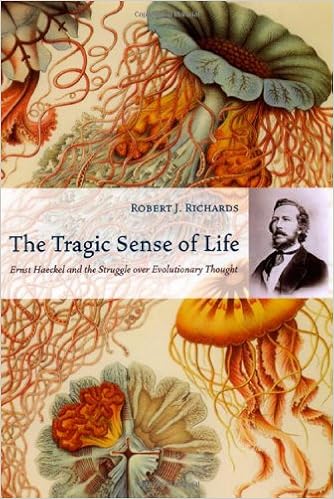
The Anna angle doesn't figure too much in the book which is a comprehensive history of the man and his influence/critics rather than a biography. I haven't read The Tragic Sense of Life by Miguel de Unamuno which this book is named after, though I surmise it's about preoccupation with death or other existentialist themes. The death of Anna brought Haeckel a tragic sense of life as she was an intellectual as well as romantic partner. Haeckel's militant monistic presentation of evolution was his way of transcending death and connecting man with the universe. I'll have to read Unamuno to understand this more fully.
I was a bit disappointed that Haeckel's later influence on individuals wasn't more fleshed out. HP Lovecraft, an ardent materialist, mentions Haeckel by name in Herbert West: Reanimator. "Holding with Haeckel that all life is a chemical and physical process, and that the so-called “soul” is a myth, my friend believed that artificial reanimation of the dead can depend only on the condition of the tissues; and that unless actual decomposition has set in, a corpse fully equipped with organs may with suitable measures be set going again in the peculiar fashion known as life." Haeckel's recapitulation also had a significant influence on early psychoanalysis, which Stephen Gould discusses in Ontogeny and Phylogeny (1977) as does Frank Sulloway in Freud: Biologist of the Mind (1977). Freud invokes the biogenetic law in the preface to Three Essays on the Theory of Sexuality (1905). "Ontogenesis may be considered as a repetition of phylogenesis insofar as the latter has not been varied by a more recent experience." Hungarian analyst Sandor Ferenczi in Thalassa: a Theory of Genitalia (1924) extended recapitulation to the development of the womb itself, arguing that our life in the womb as embryos is reliving our evolutionary ancestry in the oceans! Haeckel has had a larger influence than perhaps Richards discusses in this book by the implicit acceptance of his theories into the twentieth century. Another gripe is the little discussion of his well known Art Forms in Nature, the beautiful collection of illustrations for which he is still known for by non-scientists, though the copy I have has an introduction to suffice. This work is best read with the context of Roberts' previous work and Unamuno. Luckily the book reads very well and can be finished quickly. Good writing.


No comments:
Post a Comment