In Thalassa: a Theory of Genitalia (1924) Hungarian psychoanalyst Sandor Ferenczi connects ontogeny with phylogeny: individual development, a la Freud's Three Essays on the Theory of Sexuality (1905), with evolutionary history. The book reads like a collection of essays or lectures with the somewhat misleading title Thalassa. Thalassa was a mythological spirit of the sea from whom fish come from, so from the title I was expecting only an explication of the parallel between our ancestral lineage from the ocean with our life in the womb. The original title in Hungarian is actually "Catastrophes in the Development of the Genital Function: A Psychoanalytic Study." I learned of this work from Stephen Gould's Ontogeny and Phylogeny (1977) where he devotes a chapter tracing the influence of Ernst Haeckel's recapitulation theory to psychoanalytic thought. Instead the book really is mostly a theory of genitalia. Thalassa and the mythology around her isn't discussed at all, so Ferenczi assumes you know all that. The parallel itself is discussed in full in the chapter The Phylogenetic Parallel and in the final chapter. The rest of the book speculates on genital development, as linked to the anus (like it is with the cloaca of birds and reptiles) and coitus itself as a symbolic return to conditions of the womb.
Ferenczi uses an evolutionary theory built on Lamarckian inheritance, non-genetic acquired characteristics, and Haeckel's recapitulation, the development of the embryo parallels the development of evolutionary ancestry. Ferenczi explicitly rejects a Darwinian mechanism of natural selection to argue for the development of placenta. The placenta in which mammal embryos live in he argues is a remnant of the aquatic ancestry of all land mammals who had to develop new ways to develop offspring rather than soft eggs in the water. Reptiles and later birds evolved hard eggs, and mammals evolved live birth where development occurs inside the mother. Life in the egg or the womb which the embryo lives in is like the ocean, surrounded by life sustaining fluids. The disappearance of oceans and appearance of land are akin to the trauma of birth where animals at the end of the Devonian period had to develop new ways to breathe for themselves, much as babies do after birth. A greater dependence on the mother is the solution mammals came up with, receiving vital fluids from the mother and forming a closer emotional bond.
"For, we reflected, what if the entire interuterine existence of the higher mammals were only a replica of the type of existence which characterized that aboriginal piscine period, and birth itself nothing but a recapitulation on the part of the individual of the great catastrophe which at the time of the recession of the ocean forced so many animals, and certainly our own animal ancestors, to adapt themselves to a land existence, above all to renounce gill breathing and provide themselves with organs for the respiration of air?"
I first read in HG Wells' A Short History of the World (1922) that our mammalian nature of caring for our young is the beginning of our social life, so there is a phylogenetic parallel to our species' development.
"The earlier mammals probably parted from their offspring as soon as suckling was over, but once the capacity for mutual understanding has arisen, the advantages of continuing the association are very great; and we presently find a number of mammalian species displaying the beginnings of a true social life and keeping together in herds, packs and flocks, watching each other, imitating each other, taking warning from each other's acts and cries. This is something the world had not seen before among vertebrate animals. Reptiles and fish may no doubt be found in swarms and shoals; they have been hatched in quantities and similar conditions have kept them together, but in the case of the social and gregarious mammals the association arises not simply from a community of external forces, it is sustained by an inner impulse. They are not merely like one another and so found in the same places at the same times; they like one another and so they keep together."
Ferenczi goes further than even Haeckel who didn't think recapitulation applied to the development of placenta, as how would natural selection work on this? It is Lamarckian inheritance, which Ferenczi thinks is closer to psychoanalysis than Darwinian selection, which recapitulated our oceanic past. Some aqueous organisms found their way onto land first via pools of water and developed their own breathing and body support capacities which would mean enlarging the period of gamete development in the mother to develop these changes in safety, pushing back development of gills. The activity of the amphibians on land developed these changes, both for themselves and greater investment for offspring to have these changes, providing the fluids. But because the desire to return to the simpler oceanic life doesn't go away, these regressive instincts maintain a desire to return to the womb which simulates the feeling of being in the ocean our ancestors had. This is "Thalassal regression", an expression ultimately of the death instinct to return to a simpler existence more homogenous with the environment. The act of coitus is an attempt to return to this primordial unity, the exchange of fluids and the physical intimacy involved. Sexuality has an aggressive element, especially by the male. It is interesting to point out though I don't think Ferenczi does, that the fishy smell of the vagina is due to the chemical compound trimethaylamine, which is also found in rotting dead fish. Interesting parallel.
Sigmund Freud wrote of the "oceanic feeling" at the root of religious experience in his Civilization and its Discontents (1929) in which individuals feel an interconnectedness with the world which over powers their individual existence, fueled by remnants of infantile narcissism when one didn't have to care for oneself and was more a part of the mother. The ocean is a common example for the aesthetic feeling of the sublime, of awe and powerlessness in the presence of greatness. The ocean is deeper and stretches further than our minds can contemplate. Ferenczi provides a literal origin for this feeling as some primordial anamnesis of evolutionary ancestry.
Pre-Socratic philosopher Pythagoras and his followers identified the intersection of two circles, which forms a vesica piscis "fish bladder", as the origin of separateness, of duality. The vesica piscis is the passage of birth, literally a vagina, a symbol of fertility. This is the dyad of mother and child, separated from the original unity. And maybe the separation of our land animal ancestors from the ocean, the mother of life...
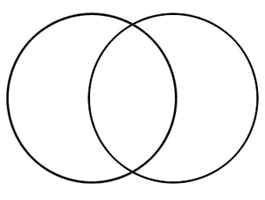
Where do you think the Christian fish comes from?
Where do you think the Christian fish comes from?
This all sounds crazy. The placenta most likely didn't evolve this way, and Lamackian inheritance is largely discredited and Haeckel's recapitulation doesn't apply everywhere. Still our ancestors did come from the ocean and life did emerge in the water, and the relationship between mammals and mother is very intimate and all encompassing. For the naturalist all things follow the same physical laws, so there are parallels to notice between the microcosm and the macrocosm. The symbolism of the explanation is pretty interesting, as the only currency of psychoanalysis is fantasy. We begin to understand the world by myth, even naturalism involved myth making. We don't really know what happened back then.
The background to all of this was the notion of a birth trauma occurring before the Oedipal complex which is chiefly responsible for both neurosis and culture. This was thought up by Otto Rank, an early member of Freud's circle along with Ferenczi who infuriated Freud with his The Trauma of Birth 1924 and soon after left his circle and went on his own. Ferenczi who was a close friend of Rank's began to distance himself and quiet his own support for the pre-Oedipal trauma as the decisive cultural influence. The birth trauma in Thalassa is rooted in phylogeny, something Freud seemed to approve of. Freud described the book as "the boldest application of psycho-analysis that was ever attempted" and supported Ferenczi's publication.
The background to all of this was the notion of a birth trauma occurring before the Oedipal complex which is chiefly responsible for both neurosis and culture. This was thought up by Otto Rank, an early member of Freud's circle along with Ferenczi who infuriated Freud with his The Trauma of Birth 1924 and soon after left his circle and went on his own. Ferenczi who was a close friend of Rank's began to distance himself and quiet his own support for the pre-Oedipal trauma as the decisive cultural influence. The birth trauma in Thalassa is rooted in phylogeny, something Freud seemed to approve of. Freud described the book as "the boldest application of psycho-analysis that was ever attempted" and supported Ferenczi's publication.
Ferenczi goes much further than the womb in the whole book, giving catastrophic moments in natural history which correspond to earlier biological development, though doesn't explicate all of them.
Origin of organic life- maturation of sex cells
Origin of unicellular organisms- birth of mature gametes
Beginning of sexual propagation- fertilization
Development of marine life- development of embryo in uterus
Recession of ocean; adaptation to land- birth
Development of external sexual organs-primacy of genitals, genital stage
Ice Age- latency period

This is a lot to take in, which is why I'm reading through the book Freud: Biologist of the Mind (1977), which also mentions Ferenczi, to understand how the bits and pieces of these evolutionary parallels developed. I hope that sociobiologists can come up with a sweeping evolutionary epic of this scale using current evolutionary theory freed of excessive use of Lamarck and Haeckel. Gould in the passage mentioning Thalassa didn't critique the theory itself but just presented its absurdity. But this is no more absurd or unfalsifiable than other myths, it's just that this uses naturalist and evolutionary mechanisms. So let this be an inspiration to make a better story if possible. There is a mythical parallel between ontogeny and phylogeny, and we do come from the water.
The development of placenta and development in the womb, which makes mammals unique, accounts for much of human behavior especially as our development takes longer than pretty much any animal. Leaving the mother at birth and after infancy is hard on us, and so must have been on the first animals to leave the oceans and develop new means to produce offspring on land. So this phylogenetic event could explain the specific adaptations of mammals and our social existence, which intensify these conditions. Social life originating distantly in solutions to rearing youth for life on land. This can be at the basis of a more sociobiological account, using the concept of the environment of evolutionary adaptedness. Placenta isn't due to a recapitulation of oceanic existence, but is a specific adaptation by land animals which replaces external egg production and then enables a whole host of unique behaviors. It's still due to leaving the ocean, but not in such an individualistic and purposeful way.
Humans being born relatively premature, taking about a year or more to walk, find social dependency a means to get past the trauma of birth and physical helplessness. Human mothers can't give birth much sooner given the large size of our craniums, and so we must develop outside the womb. What results is a growing infantilization of our physical development in which the mother plays an even more important and long lasting role than gestation and birthing. The "oceanic feeling", the longing for it, so important to facilitating social life is via paedomorphosis extended later into life, and later phylogeny recapitulates ontogeny, to reverse Haeckel. All by moving away from and physically pushing back in development our oceanic ancestry, a very ancient environment of evolutionary adaptedness.
Here's to bioanalysis!

The gill pouches called phayrngeal clefts develop early in the embryo for all animals, but don't become fully functional for full land animals. This is the typical example of recapitulation. The mother actually does the breathing for the fetus, which is surrounded by liquid. The newborn baby takes the first breath outside the womb when the umbilical cord it cut and the fluid is removed from the lungs.
Here's to bioanalysis!
The gill pouches called phayrngeal clefts develop early in the embryo for all animals, but don't become fully functional for full land animals. This is the typical example of recapitulation. The mother actually does the breathing for the fetus, which is surrounded by liquid. The newborn baby takes the first breath outside the womb when the umbilical cord it cut and the fluid is removed from the lungs.

No comments:
Post a Comment