Sunday, May 22, 2016

The Tragic Sense of Ernst Haeckel

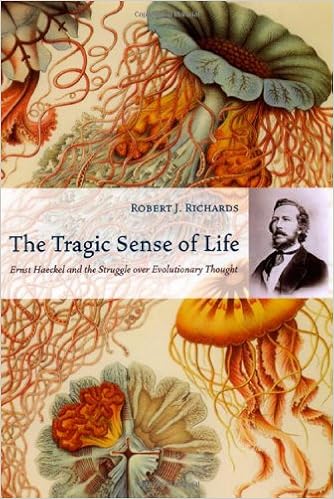
The tragic sense of life for Haeckel is also the romantic conception of life, the title of another book by Richards. The thesis of the Tragic Sense is that the biologist Ernst Haeckel shaped the public reception of evolutionary theory after Darwin more than anybody else into an anti-religious and monistic worldview because of his intellectual upbringing with the works of German romantic era writers Johann Von Goethe and Alexander Humboldt and the death of his first wife Anna which made Haeckel more militant in his views.

Haeckel is not as well known in the twenty first century. In the late 19th century his books were more popular than Darwin, as he more than anybody is the source of evolutionary thought in public consciousness. His biogenetic law, "ontogeny recapitulates phylogeny", that the development of the embryo repeats past stages of evolutionary ancestry, is still widely known and for those who accept evolution still widely believed. The early embryo has gill pouches which developed into gills for our fish ancestors, has a reptilian circulatory system, and has a fine coat of hair the lanugo like mammals which is shed before birth. Those who know who Haeckel is and are familiar with current biology know that Haeckel is a controversial figure and that Haeckel's specific law of recapitulation is considered a special case of embryonic development and not all encompassing evidence of our evolutionary lineage. Neotenous traits, youthful traits of our ancestors carried into adulthood, seem to be the opposite of recapitulation or at least Haeckel's specific version of it. The axolotl fish for example. Still even the counter examples demonstrate a profound parallel between ontogeny and phylogeny which only cuts against the specific recapitulation of adult ancestral traits. It makes sense that more primitive and shared traits with other species develop earlier in the individual in truncated form than later species specific traits. Creationists and Darwinian opponents claim Haeckel forged his famous embryo drawings between humans and different animals to make them appear more similar. Richards deals with this handily in the book and even wrote a separate article on the issue in which if the yolk sac is removed the fetuses do look similar.

Haeckel is also associated by some with Nazi evolutionary racist theories as he applied evolutionary thinking to race, even though he died in 1919 over a decade before anybody knew about the Nazis. Richards combats such claims by pointing out the association between evolutionary thinking and radical liberal/socialist movements in the 19th century, as well as Haeckel's own attitude towards Jewish people. Indeed Haeckel's legacy is because he so readily applied evolutionary thinking to every aspect of life. Haeckel meant his work for a wide audience, particularly his Riddle of the Universe 1899 (Welträthsel in German). I've read some of the book which can be found online and the monistic conception of evolution he holds goes beyond Darwin's theories. Haeckel puts Goethe and Lamarck along with Darwin as evolutionary theorists and bases his conception of the world on the law of substance, basically the conservation of matter and energy. The message of the book is revolutionary, as he notes that science had advanced much up to the late nineteenth century but old institutions like state and religion had not. The work as well as Haeckel's own religious thought is pantheistic in tone, much like that of Herbert Spencer's. Haeckel is a sort of culmination of the Spinozist influence on German thought since Goethe updated with then current scientific theory.

It says more about the state of Europe since the turn of the century that a thinker such as Haeckel would cease to be progressive and become in the eyes of many a reactionary. Critics of recapitulation claim the theory is inherently progressive and racist in its view of human nature since humans in different environments will continually diverge and push back common ancestral traits earlier in life, forming different races. Some would claim there is an element of Lamarckian inheritance if natural selection can only act on later stages, which appear during our active waking life. But Darwin and other evolutionists at the time had these elements when the theory was at its beginning. The scientific spirit of inquiry improves on such foundations. 

Recapitulation is important because it explains the apparent design of life. Critics of evolution claim that random variation cannot account for the variety and complexity of life. A room full of monkeys with typewriters would take forever to recreate the works of Shakespeare, even though it isn't impossible, just very unlikely. But imagine if every word or sentence which was correct was selected for the monkeys to begin working on, the "correct" parts being retained for future generations to work from, only changed by genetic selection of mutations. Evolution doesn't happen from scratch from random variations. Our common ancestry means we're all working from the same beginning, changing according to our environments but retaining traits which aren't selected against genetically. These vestigial traits as they're called, goose bumps and tail bone for example, are our true mammalian ancestry which becomes "falsified" by natural selection acting on our species. The parallel of individual with species development allows for a greater interconnection with nature than just natural selection on populations. The archetypal patterns of nature, first worked out in detail by Goethe and Humboldt, can be embraced without intelligent design. The romantic conception of life is infused into scientific materialism. Haeckel's collection of drawings Art Forms in Nature demonstrates the "design" in nature, featuring radiolaria skeletons. The skeletons are what are preserved after the organism dies and the design is repeated in more complicated organisms. A very helpful visual analogue to understand the naturalist appreciation of design and beauty in nature. Everything builds off the design what came before. 

The Anna angle doesn't figure too much in the book which is a comprehensive history of the man and his influence/critics rather than a biography. I haven't read The Tragic Sense of Life by Miguel de Unamuno which this book is named after, though I surmise it's about preoccupation with death or other existentialist themes. The death of Anna brought Haeckel a tragic sense of life as she was an intellectual as well as romantic partner. Haeckel's militant monistic presentation of evolution was his way of transcending death and connecting man with the universe. I'll have to read Unamuno to understand this more fully. 

I was a bit disappointed that Haeckel's later influence on individuals wasn't more fleshed out. HP Lovecraft, an ardent materialist, mentions Haeckel by name in Herbert West: Reanimator. "Holding with Haeckel that all life is a chemical and physical process, and that the so-called “soul” is a myth, my friend believed that artificial reanimation of the dead can depend only on the condition of the tissues; and that unless actual decomposition has set in, a corpse fully equipped with organs may with suitable measures be set going again in the peculiar fashion known as life." Haeckel's recapitulation also had a significant influence on early psychoanalysis, which Stephen Gould discusses in Ontogeny and Phylogeny (1977) as does Frank Sulloway in Freud: Biologist of the Mind (1977). Freud invokes the biogenetic law in the preface to Three Essays on the Theory of Sexuality (1905). "Ontogenesis may be considered as a repetition of phylogenesis insofar as the latter has not been varied by a more recent experience." Hungarian analyst Sandor Ferenczi in Thalassa: a Theory of Genitalia (1924) extended recapitulation to the development of the womb itself, arguing that our life in the womb as embryos is reliving our evolutionary ancestry in the oceans! Haeckel has had a larger influence than perhaps Richards discusses in this book by the implicit acceptance of his theories into the twentieth century. Another gripe is the little discussion of his well known Art Forms in Nature, the beautiful collection of illustrations for which he is still known for by non-scientists, though the copy I have has an introduction to suffice. This work is best read with the context of Roberts' previous work and Unamuno. Luckily the book reads very well and can be finished quickly. Good writing.

Tuesday, May 17, 2016

Thalassa: The Origin of Mammalian Existence from the Ocean

In Thalassa: a Theory of Genitalia (1924) Hungarian psychoanalyst Sandor Ferenczi connects ontogeny with phylogeny: individual development, a la Freud's Three Essays on the Theory of Sexuality (1905), with evolutionary history. The book reads like a collection of essays or lectures with the somewhat misleading title Thalassa. Thalassa was a mythological spirit of the sea from whom fish come from, so from the title I was expecting only an explication of the parallel between our ancestral lineage from the ocean with our life in the womb. The original title in Hungarian is actually "Catastrophes in the Development of the Genital Function: A Psychoanalytic Study." I learned of this work from Stephen Gould's Ontogeny and Phylogeny (1977) where he devotes a chapter tracing the influence of Ernst Haeckel's recapitulation theory to psychoanalytic thought. Instead the book really is mostly a theory of genitalia. Thalassa and the mythology around her isn't discussed at all, so Ferenczi assumes you know all that. The parallel itself is discussed in full in the chapter The Phylogenetic Parallel and in the final chapter. The rest of the book speculates on genital development, as linked to the anus (like it is with the cloaca of birds and reptiles) and coitus itself as a symbolic return to conditions of the womb. 

Ferenczi uses an evolutionary theory built on Lamarckian inheritance, non-genetic acquired characteristics, and Haeckel's recapitulation, the development of the embryo parallels the development of evolutionary ancestry. Ferenczi explicitly rejects a Darwinian mechanism of natural selection to argue for the development of placenta. The placenta in which mammal embryos live in he argues is a remnant of the aquatic ancestry of all land mammals who had to develop new ways to develop offspring rather than soft eggs in the water. Reptiles and later birds evolved hard eggs, and mammals evolved live birth where development occurs inside the mother. Life in the egg or the womb which the embryo lives in is like the ocean, surrounded by life sustaining fluids. The disappearance of oceans and appearance of land are akin to the trauma of birth where animals at the end of the Devonian period had to develop new ways to breathe for themselves, much as babies do after birth. A greater dependence on the mother is the solution mammals came up with, receiving vital fluids from the mother and forming a closer emotional bond. 

"For, we reflected, what if the entire interuterine existence of the higher mammals were only a replica of the type of existence which characterized that aboriginal piscine period, and birth itself nothing but a recapitulation on the part of the individual of the great catastrophe which at the time of the recession of the ocean forced so many animals, and certainly our own animal ancestors, to adapt themselves to a land existence, above all to renounce gill breathing and provide themselves with organs for the respiration of air?" 

I first read in HG Wells' A Short History of the World (1922) that our mammalian nature of caring for our young is the beginning of our social life, so there is a phylogenetic parallel to our species' development.

 "The earlier mammals probably parted from their offspring as soon as suckling was over, but once the capacity for mutual understanding has arisen, the advantages of continuing the association are very great; and we presently find a number of mammalian species displaying the beginnings of a true social life and keeping together in herds, packs and flocks, watching each other, imitating each other, taking warning from each other's acts and cries. This is something the world had not seen before among vertebrate animals. Reptiles and fish may no doubt be found in swarms and shoals; they have been hatched in quantities and similar conditions have kept them together, but in the case of the social and gregarious mammals the association arises not simply from a community of external forces, it is sustained by an inner impulse. They are not merely like one another and so found in the same places at the same times; they like one another and so they keep together."

Ferenczi goes further than even Haeckel who didn't think recapitulation applied to the development of placenta, as how would natural selection work on this? It is Lamarckian inheritance, which Ferenczi thinks is closer to psychoanalysis than Darwinian selection, which recapitulated our oceanic past. Some aqueous organisms found their way onto land first via pools of water and developed their own breathing and body support capacities which would mean enlarging the period of gamete development in the mother to develop these changes in safety, pushing back development of gills. The activity of the amphibians on land developed these changes, both for themselves and greater investment for offspring to have these changes, providing the fluids. But because the desire to return to the simpler oceanic life doesn't go away, these regressive instincts maintain a desire to return to the womb which simulates the feeling of being in the ocean our ancestors had. This is "Thalassal regression", an expression ultimately of the death instinct to return to a simpler existence more homogenous with the environment. The act of coitus is an attempt to return to this primordial unity, the exchange of fluids and the physical intimacy involved. Sexuality has an aggressive element, especially by the male. It is interesting to point out though I don't think Ferenczi does, that the fishy smell of the vagina is due to the chemical compound trimethaylamine, which is also found in rotting dead fish. Interesting parallel. 

Sigmund Freud wrote of the "oceanic feeling" at the root of religious experience in his Civilization and its Discontents (1929) in which individuals feel an interconnectedness with the world which over powers their individual existence, fueled by remnants of infantile narcissism when one didn't have to care for oneself and was more a part of the mother. The ocean is a common example for the aesthetic feeling of the sublime, of awe and powerlessness in the presence of greatness. The ocean is deeper and stretches further than our minds can contemplate.  Ferenczi provides a literal origin for this feeling as some primordial anamnesis of evolutionary ancestry. 

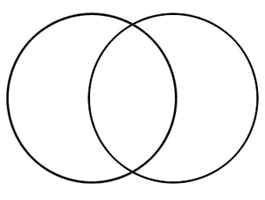
Pre-Socratic philosopher Pythagoras and his followers identified the intersection of two circles, which forms a vesica piscis "fish bladder", as the origin of separateness, of duality. The vesica piscis is the passage of birth, literally a vagina, a symbol of fertility. This is the dyad of mother and child, separated from the original unity. And maybe the separation of our land animal ancestors from the ocean, the mother of life...


Where do you think the Christian fish comes from?

This all sounds crazy. The placenta most likely didn't evolve this way, and Lamackian inheritance is largely discredited and Haeckel's recapitulation doesn't apply everywhere. Still our ancestors did come from the ocean and life did emerge in the water, and the relationship between mammals and mother is very intimate and all encompassing. For the naturalist all things follow the same physical laws, so there are parallels to notice between the microcosm and the macrocosm. The symbolism of the explanation is pretty interesting, as the only currency of psychoanalysis is fantasy. We begin to understand the world by myth, even naturalism involved myth making. We don't really know what happened back then.

The background to all of this was the notion of a birth trauma occurring before the Oedipal complex which is chiefly responsible for both neurosis and culture. This was thought up by Otto Rank, an early member of Freud's circle along with Ferenczi who infuriated Freud with his The Trauma of Birth 1924 and soon after left his circle and went on his own. Ferenczi who was a close friend of Rank's began to distance himself and quiet his own support for the pre-Oedipal trauma as the decisive cultural influence. The birth trauma in Thalassa is rooted in phylogeny, something Freud seemed to approve of. Freud described the book as "the boldest application of psycho-analysis that was ever attempted" and supported Ferenczi's publication. 

Ferenczi goes much further than the womb in the whole book, giving catastrophic moments in natural history which correspond to earlier biological development, though doesn't explicate all of them.

Origin of organic life- maturation of sex cells
Origin of unicellular organisms- birth of mature gametes 
Beginning of sexual propagation- fertilization 
Development of marine life- development of embryo in uterus
Recession of ocean; adaptation to land- birth
Development of external sexual organs-primacy of genitals, genital stage 
Ice Age- latency period

This is a lot to take in, which is why I'm reading through the book Freud: Biologist of the Mind (1977), which also mentions Ferenczi, to understand how the bits and pieces of these evolutionary parallels developed. I hope that sociobiologists can come up with a sweeping evolutionary epic of this scale using current evolutionary theory freed of excessive use of Lamarck and Haeckel. Gould in the passage mentioning Thalassa didn't critique the theory itself but just presented its absurdity. But this is no more absurd or unfalsifiable than other myths, it's just that this uses naturalist and evolutionary mechanisms. So let this be an inspiration to make a better story if possible. There is a mythical parallel between ontogeny and phylogeny, and we do come from the water.

The development of placenta and development in the womb, which makes mammals unique, accounts for much of human behavior especially as our development takes longer than pretty much any animal. Leaving the mother at birth and after infancy is hard on us, and so must have been on the first animals to leave the oceans and develop new means to produce offspring on land. So this phylogenetic event could explain the specific adaptations of mammals and our social existence, which intensify these conditions. Social life originating distantly in solutions to rearing youth for life on land. This can be at the basis of a more sociobiological account, using the concept of the environment of evolutionary adaptedness. Placenta isn't due to a recapitulation of oceanic existence, but is a specific adaptation by land animals which replaces external egg production and then enables a whole host of unique behaviors. It's still due to leaving the ocean, but not in such an individualistic and purposeful way.

Humans being born relatively premature, taking about a year or more to walk, find social dependency a means to get past the trauma of birth and physical helplessness. Human mothers can't give birth much sooner given the large size of our craniums, and so we must develop outside the womb. What results is a growing infantilization of our physical development in which the mother plays an even more important and long lasting role than gestation and birthing. The "oceanic feeling", the longing for it, so important to facilitating social life is via paedomorphosis extended later into life, and later phylogeny recapitulates ontogeny, to reverse Haeckel. All by moving away from and physically pushing back in development our oceanic ancestry, a very ancient environment of evolutionary adaptedness.

Here's to bioanalysis!


The gill pouches called phayrngeal clefts develop early in the embryo for all animals, but don't become fully functional for full land animals. This is the typical example of recapitulation. The mother actually does the breathing for the fetus, which is surrounded by liquid. The newborn baby takes the first breath outside the womb when the umbilical cord it cut and the fluid is removed from the lungs. 

Friday, May 6, 2016

Psychoanalytic Anthropology

Geza Roheim provides a concise and usable approach to build an anthropology from the psychoanalytic perspective in his The Origin and Function of Culture 1943 and Psychoanalysis and Anthropology 1950. His psychoanalysis isn't quite the same as Freud though. He is in the tradition of the "English school" of object relations of Melanie Klein, who he cites extensively. Object relations focuses on the relationship with the mother early in life as most fundamental to developing people's relationships to others in life, allowing each of us to internalize for ourselves aspects of the world to identify with to meet our needs prior to the development of the Oedipal Complex.

The fundamental assumption of a psychoanalytic anthropology is that the meaning of culture is universal due to the nature of primary psychological processes. Although the manifest content of cultures differ, the reality of our common descent via evolution and necessity of managing psychic energy (id) subject to thermodynamic laws give the same unconscious latent meaning to our actions. Symbols are used and expressed in different ways but can be universally understood because of a shared primary process. Additional assumptions are that biology is relevant to human nature and society though this relationship is dynamic and not a binary opposition of nature and nurture, human nature/society is different from the nature and lives of other animals and so a direct translation of biological explanations is not sufficient, there are differences in gender identity due to our bisexual reproductive biological constitution between males and females though each have aspects of the other, and this sexual difference is within family life the most important source of identity.

Freud if you recall had his own book on anthropology, Totem and Taboo 1913. In that book he laid out his famous "primal horde" theory of the development of the Oedipus Complex. Freud argued that the Oedipal conflict actually happened back in human evolutionary history when humans lived in polygamous groups with an ape-like alpha male who either kicked out, killed, or castrated the other males out of sexual jealousy. One day the male brothers united and castrated, killed, and ate their father to end his tyrannical frustration of their sexual desires. But the brothers felt guilty about murdering their father and substituted the father with religion, originally in the form of totem animals. Only by uniting together for a common purpose and identifying with one another could culture begin, first with a group ego ideal and then a negative superego fueled by aggressive id (guilt). Religion is fundamentally tied to culture by institutionalizing the new identity in a not all-too-human symbolic form. Culture is a formalization, repetition, of human mental processes applied to other people and later to non-human objects. Members of the tribe under the totem creature would be forbidden from killing their totem animal, unless it was a ceremonial collective action, just like the original transgression where by eating the animal they could identify with the father in a cannibalistic way, originating our social practices by a means of collective repetition. In childhood we all recapitulate this historical moment in the Oedipal phase with inherited memory, and learn to resolution in the socially acceptable way. The chapter in which the primal horde is elaborated is called "The Return of Totemism in Childhood."

Essential to the psychoanalytic theory of culture and civilization is the superego. The development of the superego is synonymous with civilization. An important assumption is that humans enter the world as fundamentally narcissists, aware of only their own needs. There is in the womb no distinction between our needs and the needs of the mother. When born we are cared for by others and learn to manipulate at first by our cries to fulfill our needs, while not having to help anybody else. The superego develops from childhood experience with our caregivers, where the ego identifies with some aspects of the caregivers. The superego as it is unique is negative in character.  The superego is different from the ego ideal, self-identity with the parents which is largely positive for us. The superego's power is from an instinctual anxiety and fear of loss, a negative means of preventing deviation of behavior from the ego ideal. The superego gets its power from the id against the ego by channeling aggressive feelings against it, which is what makes its character negative toward the ego. The need to identify with others is because of our separation yet continuing need for them. We have taken others in as a self ideal, but our social existence maintains a conflict to keep us in line. This happens in two major moments; at birth from the mother, and later in the Oedipal stage of sexual differentiation from the opposite sex parent. The first identification is with the now external object, the mother, the latter identification in the Oedipal stage is erotic love of the object in a realistic form of a different person and sexual identification with the same sex to gain the object. Freud asserted the latter as the decisive moment of culture using his primal horde evolutionary explanation. The murder of the father is the greatest crime of human history which can only be resolved by collective rather than individual identification with the father due to an actual phylogenetic event.

Roheim accepts the Oedipal Complex as universal and formative of social identity but disagrees with Freud's reasoning of how it came to be universal. Freud's primal horde was formulated partially with Lamarckian inheritance of acquired characteristics and Ernst Haeckel's recapitulation theory, the development of the embryo repeats past evolutionary stages, which were already in Freud's time already coming into disuse. For Haeckel, traits shared with earlier stages of evolution are developed earlier in life, in the womb, to allow for traits unique to the species to develop from natural selection, a process called terminal addition. It is true that early characteristics are shared in the development of all embryos, emerging at different times depending on how closely related they are. But natural selection can act on any stage of development and Haeckel's original formulation was that adult traits are recapitulated, whereas the gill pouches in human embryos never develop into functioning gills like they do for fish. We repeat the early shared traits of ancestors but not their entire stage of evolutionary history. Still there is a parallel relationship between the development of the individual and the species in which the past is preserved. We can escape the past, as well as maintain the past at later stages of life in the reverse of strict recapitulation called neoteny which I'll talk about.


Jean Baptiste Lamarck theorized that traits that were inherited were acquired during the life of the individual organism, the famous example being the giraffe's long neck evolving by the stretching of ancestors to higher and higher tree branches. Body parts used more become stronger and are selected for progeny. Lamarck's theory was discredited as knowledge of genetics improved, demonstrating that genetic information in the cell is only changed by copying errors, mutations, not muscular or hormonal activity, though recent research in epigenetics indicates expression of genes may be changed by life experience of the parent. Freud thought he could utilize acquired characteristics for primitive memory traces accompanying our genetic endowment. Reactions to internal psychological needs, not just environmental challenges, could be inherited.

These evolutionary theories are not needed for psychoanalysis which deals with fantasy, but would tie it to biology the way Freud learned it in the 1870s.

Utilizing object relations theory, Roheim bypasses the Oedipal struggle against the father as the basis of society, the superego, and points to early childhood after birth and the mother. It is our prolonged dependency on the mother due to our helplessness at birth that makes human beings unique and enables society. This relationship is the same for both male and female. Following more modern biological opinion than strict recapitulation of ancestral traits or memory as defining childhood development, Roheim uses neoteny, the retention of youthful traits into adulthood, as the factor for social development. Our retardation of development such as being born relatively prematurely and long childhood makes the influence of others very powerful on us. We never get over the infantile fear of being alone and helpless, and so we learn to identify with others and narcissistically express the same desires and fears with others in acceptable ways, to not be ostracized, to get over this trauma.

Neoteny is a powerful explanation for what makes humans unique from other apes. Our flatter faces and big heads are more similar to baby chimps than to adult chimps. Mentally youth is associated with more brain plasticity and curiosity, a greater ability to learn more things. The retardation of development allows our big heads to come out of the mother's womb without burdening her bipedalism, but this means we have to develop prematurely outside of the womb. We only learn to walk after a year whereas horses can get up and go within hours of being born. It takes us nearly twenty years to become adults, and even then we do not escape the influence of our parents.The cost of intelligence is helplessness, the solution to which is dependency.


Humans forever want to relive their infancy as adults. A major conflict for humans is that we develop sexually while still under parental influence before we can live on our own. From infancy we express sexual behavior such as tumescence, pelvic thrusts, and muscular orgasm without ejaculation. Our minds develop under conditions of parental dependency past the time of physical dependency, as do our sexual desires. Sexual expression is frustrated and is molded by our social dependency on others into acceptable outlets, until a later age when reproduction and pair formation are possible. We eventually learn to separate ourselves from the parent for the fulfillment of our needs, and trouble in this leads to neurosis where we continue to relive the past mentally while we mature physically (sexually). Neurosis is a failure of identification with others from our past which precludes us from providing our current needs.

Roheim talks about the body destruction fantasy, a fear of annihilation from helplessness, which is resolved by substituting our own body for the mother as the source of satisfaction of our needs and developing proper social skills to elicit help from other people. This is in effect an earlier occurrence of castration anxiety for males in the Oedipus complex and the beginning of the formation of the superego, identification of the self with aspects of the mother to avoid anxiety. The primal scene which begins the Oedipal stage is a scene of unification of the mother with somebody else, the father. The father remains with the mother because of a similar infantile attachment from his own mother, which is what the Oedipus complex universal. The triad replaces the dyad. Being weaker than the father, the male learns to identify with the father to have his own mother to unite with, to recreate the child-mother dyad by joining the triad as the father. This is when the formation of the superego takes hold for Freud, but the early strong dependent relationship with the mother is what originally fuels this need and engenders hurt feelings from exclusion from the primal scene. A fundamental part of ourselves is being excluded.

Culture originates from all of this via sublimation. Culture is itself a defense against infantile anxiety, a neurosis which brings us together. The difference between "normal" people and neurotics in society is that neurotics isolate themselves from others by not adopting socially accepted forms of wish fulfillment. Society allows us to share our narcissistic desires with the same external expressions.

Examples of Roheim's: The soldier reenacts body destruction and Oedipal conflict, the lawyer engages in struggle between id ego and superego, a scientist is a voyeur of mother nature's secrets, a painter continues to play with feces, and the writer of fiction never renounces daydreams. All sublimation of infantile desires with the comfort of society's approval and protection in place of the parent.

Economics is imbued with the erotic worship of objects by a process of indentification. The first true occupation unique to society is that of the medicine man or shaman. The shaman doesn't have to hunt or gather food all the time and can live out neurotic fantasies more than others who work, and do it for them too. From the medicine man comes the trader who attributes a fetishistic value to objects apart from their original use (Marx commodity fetishism?). The shaman is the first to substitute care of the spirits of others for himself and rend services for others. Agriculture and domestication of animals is itself a repetition of infancy, learning to care for the seedlings and younglings of plants and other animals. This is where we originally get the totemic animals, from a love relationship patterned after our own emotional relationship with the mother.

This maternal explanation seems a far cry away from Freud's Oedipal primal horde where the father plays the leading role. The title of the book is The Origin and Function of Culture, and it would seem the Oedipal moment occurs later in life and phallic gods occur later in human development, after we mature from our prolonged infancy. 

Mother Nature seems more primal and immediate than God the father. Maybe Freud focused too much on Greek myth and the Abrahamic God? The Abrahamic religions do condemn infanticide pretty strongly with an all good male personal deity, whereas the Greek gods are involved in human affairs but not always in beneficial ways. The Greek gods can be seen as a transition to the rule of the patriarchal male who we all are supposed to identify with after we get over our extended infancy. The superego develops more gradually and begins earlier in life with the mother for both sexes.

The Cro Magnons of Europe tens of thousands of years ago did their art deep inside of Mother Earth


Venus of Willendorf, a prehistoric female figurine which is speculated to represent fertility and maybe prehistoric matriarchal religion

The reason for the universality of the Oedipus complex is the continuation of the mother-infant relationship influence into adulthood. It is because the father sticks with the mother. In the vast majority of mammals paternal investment is very little compared to the mother, and males of other species often engage in infanticide against children that aren't theirs, acting selfishly for the propagation of their genes. Adopted children are even today far more likely to be abused than if they lived with their biological parents. A major achievement of the human race is getting males to invest in their children and the mother, and eventually to non-kin, society as a whole. Getting males to fork over their wealth to the state in taxes. Taking care of children is costly and the male only invests their sperm toward reproduction, giving less of an incentive to care for the child compared to the mother.

Greater paternal investment had to begin with object love, but not initially for the children. Males stay with the mother after the birth of the child because of their own infantile attachment developed from their own mother, but in this case capable of erotic expression with someone else. This seems more of a result of culture than the origin of it. Paternal care is a reaction formation; instead of killing the offspring the father in some way identifies with them as wanting the mother's love, which would include not killing her babies. The lingering result of delayed development and dependency. On the child's part sexual feelings develop under dependency, and in the adult infantile feelings remain after dependency. Not only are hurt feelings in the child, but also from the adult male's past which would encourage paternal involvement. The primal scene, the triadic sexual union of mother and father, is the reason for the push for monogamy for most humans over history. If the father didn't hang around due to a strong emotional attachment, there wouldn't be an Oedipal conflict. The moral superego wouldn't develop further into phallic sky-God religion, creating a moral revolution, without this male influence on identification.

Phylogeny seems to recapitulate ontogeny, to reverse Haeckel's phrase. The development of human culture repeats the early dyadic child-mother maternally driven relationship first and later on starts repeating the Oedipal triadic son-mother-father paternally driven relationship. We only "progress" as societies when we get over our long period of dependency and express later relationships in our culture. The early maternal relationship remains very powerful for us humans. For Haeckel, as mentioned earlier, traits shared with earlier stages of evolution are developed earlier in life, in the womb, to allow for traits unique to the species to develop, via terminal addition. Humans have managed to reverse this process when it comes to infancy and have difficulty growing beyond it to become more specialized, as other species do in their environments under natural selection. We are spared the reality principle, the struggle for survival, for a long period. This is the cost of our intelligence and sociality, our dynamism.

The Oedipal moment in history if it did happen the way Freud described was prompted by a love for the mother as much as a hatred of the father for frustrating sexual desires at the end of a process of neotenization. The attachment early in life from a long period of dependency is possibly what helped humans to move away from the polygamous social structure of ape society. The father's exclusive sexual access would've engendered more hurt feelings with the growth of this attachment, and encourage monogamy with future mates. This explanation works with the "hunter hypothesis" of Robert Ardrey and Desmond Morris, that the transition from ape to man occurred because males had to learn to cooperate to hunt big game once we left the security and sustenance provided by the trees. Having an alpha male with an exclusive harem of females would create hurt feelings amongst the hunter men who developed an attachment to their own mothers during prolonged infancy, which also enabled them to have the brain to develop tools and communicate. Any male who brought back this deep anxiety would be met with the force of cooperating males with weapons, all enabled by maternal dependency relationship. A more monogamous society would guarantee a payoff for the renunciation of aggressive instinct by the males that cooperation requires. That is what brought an end to the primal horde.

Unique aspects of human culture such as paternal investment, monogamous pair bonds, social cooperation and condemnation, shared phantasy life, and religion all begin with the prolonged dependency of the child and the mother. The universal Oedipal Complex occurs later in human development when the father relationship becomes more important, itself due to mother-infant tie, to individual development and conflict for males. This pushes superego development further with aspects of the father, and eventually becomes projected onto non-human animals, objects, and eventually nature itself due to various resolutions of the Oedipal Complex. It is after all this that economic/technological explanations such as those of Friedrich Engels become important (after the control of fire).

Wednesday, May 4, 2016

Urination, Sexual Selection, and the Control of Fire

Control of fire is the most important invention of human history. Only language comes close, which didn't come to a written form until 5,000 years ago. Control of fire in a systematic way occurred anywhere between 100,000 and maybe over a million years ago, presumably by our ancestor Homo Erectus. For Homo Sapiens it definitely happened during the last ice age, 2 million to 12,000 years ago. The evidence we have is from charred remains at human sites, from temperatures too hot to occur on their own as well as physiological changes suggestive of eating cooked food. Control of fire contributed to important changes in human evolution. Most importantly humans activity was not limited to daylight, providing light and warmth for the almost hairless ape. Fire allowed our ancestors to develop new kinds of tools and weapons, creating the art of metallurgy. Cooked food it is speculated contributed to physiological changes lime decreased jaw size, shorter digestive tracts, smaller teeth and a larger cranium to house our big brains which differentiate us from the apes. Our diets could contain more energy, to fuel our expensive brains and it is speculated decrease male-female dimorphism, difference in size between males and females, I suppose by increasing the food to share, reducing male competition.

How was the ability to control fire discovered? This is something we don't really know, despite our knowledge of its many effects. Humans didn't learn it from observing other animals, so far as we know. The well known explanation from Greek mythology is that fire was given to humans by the titan Prometheus who stole it from the gods. For this Prometheus was chained to a rock where his regenerating liver was to continually be eaten by an eagle. In fact the theft of fire from the gods is a recurring theme in different culture's mythologies, found among the native North Americans, though usually with animals stealing the fire. It's clear that the control of fire was an epochal event in human history for all cultures.

Sigmund Freud looking at such myths provided the most interesting if most bizarre at face value account for how fire was controlled. First in a footnote in his classic Civilization and its Discontents 1929 he speculated while admitting the paucity of evidence that the control of fire was the result of males renouncing the urge to urinate on fires they came across in nature. The pleasure of such activity can shared with other males, as women are anatomically unable to urinate on fire. One day a male renounced this infantile homosexual desire and was able to take the fire back to camp for his own use, and for females to take care of, not having the same urge to put it out. 

"Psycho-analytic material, incomplete as it is and not susceptible to clear interpretation, nevertheless admits of a conjecture – a fantastic-sounding one – about the origins of this human feat. It is as though primal man had the habit, when he came into contact with fire, of satisfying the infantile desire connected with it, by putting it out with a stream of his urine. The legends that we possess leave no doubt about the originally phallic view taken of tongues of flame as they shoot upward. Putting out the fire by micturating – a theme to which modern giants, Gulliver in Lilliput and Rabelais’ Gargantua, still hark back – was therefore a kind of sexual act with a male, an enjoyment of sexual potency in a homosexual competition. The first person to renounce this desire and spare the fire was able to carry it off with him and subdue it to his own use. By damping down the fire of his own sexual excitation, he had tamed the natural force of fire. This great cultural conquest was thus the reward for his renunciation of instinct. Further, it is as though woman had been appointed guardian of the fire which was held captive on the domestic hearth, because her anatomy made it impossible for her to yield to the temptation of this desire. It is remarkable, too, how regularly analytic experience testifies to the connection between ambition, fire, and urethral eroticism."

Freud in his later essay The Acquisition and Control of Fire 1932 examined the Prometheus tale and argued that its content is fundamentally phallic. Prometheus gives fire to humans win a hollow tube, emptied of urine(?). The eagle eating his liver is the homosexual phallus, and the liver was thought to be a seat of emotions. The continual assault on the liver and its regeneration is the indestructibility of the suppressed desire to not extinguish fire. The urinary function of the penis is tied to its sexual function, as children have the theory that daddy impregnates mommy by peeing inside her. 

Hercules in his legend uses fire to defeat the hydra and comes to release Prometheus. Hercules reverses what humans did; instead of putting fire with liquid, he put out the water beast with fire. By being able to relive the desire, presumably by burning things which many little boys do, man can overcome the original cost of instinct renunciation. The triumph over nature, over other beasts, paid off for the investment. 

This explanation continues to offend many people, like most of Freud's theories. But when analyzing legends just like dreams, it is the latent content that is important. Humans first learn about themselves through myths, and gain knowledge about their own self through dreams. It is only after analyzing the content of these myths and dreams that we can get some understanding of the world before written language or modern notions of self-consciousness and philosophical naturalism. To argue that our ancestors discovered fire by trial and error of observation or some sort of experiment is to project our thinking into the past, a way of thinking that has grown out of and had to overcome thousands of years of myths. 

I think however that Freud is missing something very important in his explanation, something from evolutionary theory which can make more sense of his explanation and not rely on myth interpretation. This factor is sexual selection, a type of natural selection in which physical traits are chosen, that is inherited, not to adapt to the environment but to increase success in mating. An example of this is the male peacock's tail which is highly visible to predators and costly to develop and maintain, but attracts female peacocks, who do not have this plumage. Traits can be selected for which do not increase environmental fitness but contribute to signaling reproductive fitness for females or help males compete. It is expected that given the difference in investment between males and females, males contributing sperm while females have to carry the child to term, females will be more "choosy" with mates and males will have to compete with other males for mates. Women limit the amount men can reproduce given that having more women than men means more offspring than more men than women (polygamy is more common than polyandry) given that human females can only have one child every nine months.

As sexual dimorphism decreases with humans, women get more power to choose on factors to their liking. The difference in size between men and women is thought to come from our more polygamous past. As we became more monogamous, male competition decreased to challenge the alpha male and females had more freedom to select mates. It's obvious what men want in females, small waist to hip ratio and large breasts. Females chose larger penises in men. Human genitals are enormous relative to other mammals, and their size does not enable greater ejaculation or urination, making sexual selection the most likely explanation for human male genital size.  

We don't see many animals urinating on fires they come across as Freud speculated human males did when they came across fire. This is because humans are pretty much the only bipedal land animal. How would a wolf pee on a fire, go up to it and raise his leg? That would be too risky, and would have to be a very small fire. Or pee on top of the fire? No way. Bipedalism allows humans to be at a safe distance from the fire to urinate on it. Large penises, via sexual selection by females, would give bipedal human males aim to douse the fire. 

Does it have to be urine that put out fires? Maybe not, but it makes the most sense. What else immediately available would put out a fire? Dirt? A blanket? Could use water, but that would be wasteful and have to be transported. Urine is immediately available and requires little opportunity cost to have in store, it occurs naturally in the body. Being at a safe enough distance would preclude just running away, and the fire would be dangerous enough to not want it to spread. 

Coming across fire would most likely be at first an anxious experience, encountering fire from a lightning strike or bush fire directly would be unfamiliar, especially in a relatively safe position. Thus putting out the fire would be an almost instinctual reaction. It would take effort to resist the urge. Unlike Freud, I think the urge to put out the fire is not just sexual but also from fear. The anger of the gods for taking fire is our continued fear of the power of fire, the power of nature. Zeus is the one who threw lightning bolts, a source of fire. The control fire is basically a renunciation of instinct, both sexual and anxious, enabled by male physiology. The ambivalence of the encounter encourages its extinguishment. 

The male ambivalence toward fire as an object of arousal and fear would only end once women also had control over fire. Women as in Freud's original formulation don't have the same urge to urinate on fire for anatomical reasons and in the presence of fire would evade or use it in a safe setting. Getting fire back to the women would be advantageous to the male who accomplished relative to other male competitors, so sexual selection again. The women at home then could use it for cooking, warmth etc according to the sexual division of labor, and not have the same urge to put the fire out. The control of fire is enabled by women, their love replaces the ambivalent instinctual relationship towards fire. 

Man first learned sublimation, the channeling of sexual desires into different productive ventures, which would enable the rest of the process of civilization. Man is rewarded by woman for the triumph of intellect over the desires of the penis, as it were. 

There you have it. Sexual selection meant that bipedal females chose larger penises for bipedal males who urinated on fire when encountered in nature at a safe distance, and humans learned control of fire when a male renounced the ambivalent sexual and anxious attitude towards fire and brought it home for women, and this improved his chance for mating and provided benefits for the group at large. Women protected the hearth not having the same urges to extinguish fire and used it in the sexual division of labor. But fire remains for a very long time and even today something mysterious and powerful. The renunciation of instinct and nature's control shows up in legends substituting gods or animals for men taking fire from nature and giving it to others. 

In this story, humans don't yet learn how to produce fire at will. But we do learn to be familiar and comfortable around it and it's uses when it occurs in nature, bringing it to camp and getting warm, cooking food, and/or making rudimentary tools. Fire becomes the first in a long line of technological advancements which alter human nature itself. 

The sexual selection explanation is as male driven as Freud's original explanation, but I'll have to look more into the decrease of sexual dimorphism and the role of female choice. My reading of psychoanalytic literature after Freud criticizes his emphasis on the phallus and the whole Oedipus complex as the determinant of human culture. Nonetheless the phallic content of the Promethean myth is important to consider. My sexual selection explanation differs from Freud's I think in giving women more of a direct role than he did. 

The phallic symbolism could just be symbolism and the urination story can still be useful. The important point is that renunciation of instinctual desires towards the unfamiliar led to our control of nature. It was an internal repression of our energy channeled towards new productive means which is the basis for society. A parallel is with the domestication of dogs, which also occurred during the last ice age. We and the proto-dog wolves around our ancestors campsites had to renounce our mutual fear and desire to eat one another so we could live together. The benefits of domestication aren't as immediately obvious as evading danger or consumption of meat, for both human and dog. An affective attachment must have developed from chance, of wolves following humans and eating our leftovers, which would alleviate this anxiety. We had to take an active step to domesticate the animals and get over our fear and desires. The risk takers who went against their instincts were rewarded with man's best friend. Accomplishing this would be quite advantageous to the male and the females of the camp would be willing to care the wolves and their pups with perhaps not the same urge to evade or kill. 

Before the invention of language/writing we don't have any notion what the humans who discovered fire were doing, let alone their motivations. The only currency we have from the past about this event is myth and fantasy, which is of scientific value for its latent content. All we have to infer prehistoric events are these remnants. So Freud's explanation with modifications from evolutionary thinking suffices for me.

From Conatus to Drive Theory

Spinoza's Conatus 

For some reason, Spinoza has had a very strong influence on German philosophy since the late 18th century. Chiefly because of Johann Von Goethe, German idealism and German philosophy hithero have strong Spinozist overtones, chiefly a pantheistic/monist view of the universe. There is another way besides pantheism and monism that Spinoza seems to have influenced German thinking. This is in the view that willing is part of the universe, that living things have an internal drive to preserve their form. This is known to some as vitalism when applied only to living things and voluntarism when applied to the world. Spinoza's conatus brought this thinking into modern philosophy, having its roots in Stoic doctrine but updated with the revolutionary law of inertia to be a distinctly physical phenomenon.

In the 18th century there was an ongoing debate about how life developed. Was it purely material causality, mechanical, or was there formal design? Does the embryo develop from a mixture of male sperm and the female egg, or is the complete animal already existent in the sperm as a tiny version of itself? The former theory was called epigenesis and the latter preformationism. Today we mostly accept epigenesis when it comes to embryology, though the development of DNA and the arguments that genes determine behavior harkens back to preformationism. The notion that there exists a small version of the fully developed organism inside male sperm seems downright ludicrous today, and also totally sexist( the meaning of "before you were formed in the womb I knew you"). But what these theories debated was the question of whether living things are different and develop differently than inorganic material things which is still important.

Vitalism became the new theory to oppose the mechanical view of living things. Instead of a prevenient design, living things have a force or a fluid unique to them. This force or material is what makes organic things grow in a certain way. Vitalism is considered debunked or as pseudoscience today, specifically the claim that organic compounds cannot be synthesized from inorganic compounds. The problem is in specifying something either supernatural or not known by natural sciences which can be proven or disproven, or relegated to philosophy, such as Henri Bergson's once popular Elan Vital. However the question of what makes life different from non-life continues to be debated.

In German, the opposing views are kraft and trieb, force and drive. A force is what an object has or imparts onto an object a state of motion or rest. Kraft is external and mechanical change, dependent on the inertia a body has. Trieb or drive is the becoming nature of something, the impetus to grow a certain way and maintain a form. With the growing influence of epigenesis by the 18th century animals were coming to be viewed as dynamic not static creatures which are defined by developmental contingency not the unfolding of a plan. The word evolution was used before the mid 19th century to describe preformationist theories, as the word evolution means "unfolding." But if animals are dynamic, what makes life different from non-life? Are living things just complicated machines able to manufacture copies of themselves?

Johann Blumenbach the 18th century biologist described life as having a bildungstrieb, a formative drive. This is a tendency to grow a certain way and maintain a certain form under resistance. He discovered this by cutting up plants and observing their ability to regenerate parts. The bildungstrieb differs from vitalism in that it is descriptive and not a special force or fluid. There's no reason to believe that organisms have something extra to make them alive, they just behave in a way which preserves their existence. As with Spinoza's conatus, the drive is the internal aspect of the same world experienced in a different way.

“In all living creatures from the human to the maggot and from the cedar up to the steed there lies a particular, inborn, effective drive active throughout life, first in order to attain their specific form, then to maintain it, and if it is destroyed, to restore it where possible.” Blumenbach

The bildungstrieb united the mechanistic explanation of biology with aspects of teleology, which Kant described as teleonomy, the apparent design we see in things. We can only understand living things by ascribing the appearance of purposeful behavior even if that isn't what is really happening. It works that way from an individual perspective because we see the finished product and not the contingencies involved. The process of selection results in what seems purposeful by a sort of disguising of history.
Much like Spinoza's conatus, drive theory is not teleological from the cosmological perspective. Species are not static and the telos is from self-preservation. Only individual things in so far as they persevere have ends, which over time in relation to environmental selection determines the nature of the species.

The notion of drive entered into German thought via Blumenbach as well by Spinoza's philosophy of conatus. Immanuel Kant, Johann von Goethe and Friedrich von Schiller adopted the bildungstrieb into their thinking.

Darwin's theory of natural selection incorporated aspects of drive thinking by giving a naturalistic explanation of the apparent design and complexity of nature through the struggle of living things against their surroundings. Evolution, "unfolding", could be used by naturalists to explain the nature of life. German poets and philosophers like Johann von Goethe presaged evolutionary thinking because of their attempt to square naturalism with a vital life force. Goethe in his work with plants revealed for him an archetype of living things, the urtypus, which things grow from, like a common ancestor from which analogous, homologous, and vestigial structures emerge in descendants. Among German intellectuals evolutionary theory was along with drive theory part of a monistic philosophy of the universe, most prominently by the German Darwin Ernst Haeckel in his The Riddle of the Universe in 1899. It was because of their predisposition to evolutionary thinking combined with the monistic and non-dualist philosophy which allowed them to incorporate natural selection into a comprehensive world view. Whereas in Anglo societies Darwin's ideas more than in Europe are still controversial, with the largest number of creationists being in the United States and a significant number in Britain. Alexis de Toqueville said Americans were Cartesians without ever having read Descartes. It is I think the static view of instinct and the separation of mind from body which makes it hard for many Americans to understand evolutionary theory and think that it portrays the universe as random and meaningless, if not for an intelligence like humans above and beyond the material world. 

Monday, May 2, 2016

The Problems of Philosophy by Bertrand Russell

I read The Problems of Philosophy over a century after it was published, and it's remarkable how well it has held up. A much more recent philosopher who is alive Daniel Dennett described philosophy in a TED Talk as making sense of what the sciences tell us. Russell himself described philosophy as concerning problems science hasn't yet answered or found a way to frame the question in a way it could be answered, and as a critical means of unifying the sciences. Philosophers still debate the nature of consciousness, free will, sense data, God, morality, Justice etc which the sciences still haven't taken over. The discovery that space and time don't always work the way we think we do was known to Russell back in 1912. The content is still relevant to philosophical problems today. 

The specific problems of philosophy are the difference between how we perceive the world and how it actually is (if there is a difference), the nature of physical objects and how we come to know them, the existence of universals like the kind we use in discourse, and the justification of truth. Absent are discussions of more "hot button" controversial issues like free will, God, ethics, or justice. Russell by his own admission follows in the tradition of modern philosophy since Rene Descartes and begins with doubt. Whatever cant be doubted should be the basis of philosophy if we are to find any certainty to our beliefs. This is a very different understanding of philosophy than the ancient Greeks or medieval thinkers had, and was inspired because of how wrong these old trusted authorities were about many things. This way of thinking precludes moral and metaphysical thinking until a basis for them is established, which is what Russell is trying to do here. It is critical for if there aren't things like universals as Russell thinks there are then universal morality and justice are in question. In Russell's time the certainty of the Newtonian worldview of classical physics was being undermined by the discovery of non-Euclidean space and the nature of light as a physical phenomenon, etc. Advances in logic, which Russell helped pioneer, made many philosophical questions capable of an answer or at least clarification. This of course became the "Analytic" school of philosophy which is dominant in English speaking countries. 

Russell can be described as an indirect realist. He acknowledges the difference between perception and reality, and that all we know if what we perceive, which is sense data. Yet he believes we can infer the independent existence of physical objects. Besides immediate sense data we have memories which gives us a sense of a past which is no longer. Next we alone among animals are aware of our own awareness, self-consciousness. We surmise that this thinking activity belongs to a self, which is the first relation to a universal concept we know. Our awareness of properties apart from instances implies something common with them. 

Yet Russell shares Hume's skeptical doubts regarding the "I think therefore I am"; that among our different thoughts there exists a self which is not located in any of these thoughts. So universals are relations between things, not an actual thing as it was for Plato. Universals have being, but not existence. For it to be true that Russia is north of Turkey, there must be truth to the relation north. The relation north is not mental or physical, it is just in mind, kind of like the self. This is the most confusing but I think crucial part of the book to establish Russell's indirect realism, and any realism I suppose. 

Idealists and phenomenalists argue that these relations are mental, either constituted by mind or not independent of the phenomena we're describing. Russell devotes a chapter refuting idealism by claiming it conflates having an idea of something in the mind as constituting the nature of that thing. As Berkeley argued, for something to exist it must be perceived by a mind, either our mind or the mind of someone else like God. Yet my having an idea of a tree doesn't really constitute its essence besides it being a thought of something. I don't get anymore information than that from just the having of an idea. As for phenomenalism I think he spends the whole book trying to argue not that it's wrong but that there is more than sense data. But his accordance with Humean doubts makes that difficult. Perhaps if he was a direct realist this wouldn't be as much a problem.  

An important distinction he makes is between knowledge by acquaintance and knowledge by description. It is possible for something to be true without our being familiar with it. It's true that Australia exists because others who are acquainted with the country can describe it to me in ways I'd understand if I had been there. This is like the criteria of replicability for experiments, under the same conditions the same conclusion should hold. Of course the phenomenalist would define this as the possibility of experience, not the knowledge of something without experience. This distinction relies on his acceptance of universals, more important than I realized.  

Russell holds what is called a correspondence theory of truth. All true statements refer to something beyond themselves, be it physical facts or universals. He has three requirements for truth: 1) truth has the opposite falsehood possible 2) truth is a property of beliefs 3) truth is related to outside things. The opposing theory of truth is called coherentism; the truth of a statement is relative to the truth of other statements. Something can be true in a circular way, coherent with one's background beliefs, and not refer to anything outside. Coherentism accepts the first two criteria of truth and denies the third. Russell claims that by relying on noncontradiction for coherence this view depends on the truth of logic being itself independent of statements. Again the importance of universals. 

The rest of the book from beginning to end is familiar ground for those with background knowledge of philosophy. He recommends Plato's Republic, Descartes' Meditations, Spinoza's Ethics, Leibniz's Monadology, Berkeley's Three Dialogues, Hume's Enquiry, and Kant's Prolegomena to any Future Metaphysics for beginners from which he draws from all heavily. 

What Russell gives in this short book are the important questions from the foundations of these author's arguments, minus the historical idiosyncrasies. Given the depth of Russell's work, this is a simple and very accessible book which does a good job of summarizing modern philosophy, even in the 21st century. I pretty much agree with it. 


Sunday, May 1, 2016

The Universe as Energy

The world is fundamentally unconscious will which is divisible into what can be described by the physical concepts of matter and energy, which are the causal constructs imposed by consciousness on the metaphysical will.

The world is comparable to a continual transfer of electrical energy into mechanical energy and vice versa. The continual motion of mass via energy. The transfer of photons between electrons and the transfer between gravitational energy to kinetic energy between material bodies. Wavelength motion in mediums. Motion and attraction/repulsion between bodies. Enough energy for some reason was converted into rest mass so that space is filled with objects which light passes through, taking different forms in these processes which result from the motion of light energy through mediums (heat, color) and governing interactions between the objects in space exchanging electrical charge (electromagnetic force). 

Space and time, as distinct from our perception of them, are physical things which are affected by energy. What we call space is just another feature of the gravitational field of the universe; space-time does not exist apart from the matter and energy that creates the gravitational field. Energy is convertible into mass, e=mc^2. Energy and mass warp the fabric of the phenomena of space-time. 

It is the existence of matter that allows us to see light in a visible form, both as an object and as a subject. 

A world of pure light would be blinding and incomprehensible. Light become matter so that we could comprehend it, so to speak. A world of pure space would be dark and indistinct, without light. The existence of material objects gives us the contrast of the light and dark, light and "empty" space. Pure light and pure dark have no color, just as when one looks directly into the sun or into space. It is the sky around the sun and the planets in space which have color.  It is the interaction of energy with mass and space-time which constitute the world we inhabit.

In light we can understand how the different things can be fundamentally the same, such as mind and body. Light has aspects of both particle and wave; a field of force and a particle. Our vision is due to the mechanical movement of the retina and the transfer to electrical energy via the optical nerve to the brain. In a medium light travels at different wavelengths, which seems to slow down the speed of light. However the speed of light is finite, even in a vaccuum. Light still travels faster than anything else in a medium, so the the law of causality still holds for other phenomena. This is how people can see different colors, while the wavelengths of light being the same.

Light is our awareness of the world, our personal connection to the universal energy. Light is the free energy not bound to do work by its nature. After exchanging energy with objects, light travels at its speed as a massless particle. Thought processes are synonymous with the nervous system which is comparable to a system of electric signals. Mind's qualities of simultaneity and instantaneity of events as compared with matter is like the activity of an electromagnetic field. Electromagnetic processes occur at the speed of light, a transfer of energy from one particle to another. The speed of light is the speed of causality because it occurs faster than anything else as it is in itself free of causality. Light travels faster than anything else because light has no rest mass, meaning that there is no energy to overcome to accelerate. At the speed of light all there is no distance between events, there is no before and after, only the present. 

It is everything else, including our bodies, which have rest mass which fall under causality. Since force equals the product of mass and acceleration, F=MA, with no rest mass the speed acceleration is as great as the energy gained by motion. As E=Mc^2, light is pure energy free of individuation within space and time since light has no rest mass to overcome its acceleration. 

The existence of rest mass, our body, is the physical analogue to desire as the source of suffering. Because of rest mass we don't live in the present. We can imagine different states of affairs, but not always act in accordance with them. We have to choose among alternatives presented and not created by us. We form expectations about the future and fixations about the past which do not reflect the present. In animals and indeed for most humans in most of their history little energy was free to speculate on the different possibilities. Thus for us the idea is different than reality, creating duality and opposition between things. But living things are dynamic, constant energy converting machines. The meaning of the idea is only in the transient individual forms. The objects of consciousness define the meaning of existence. Individuality and suffering are bound into the nature of conscious existence.