"Life itself is only a vision. A dream. Nothing is real except empty space, and you. And you are but a thought."
Thursday, October 29, 2015
Empty Space, and Me

The Market and Care
The idea behind commerce is that I do something for you not because I care about you, but because I can get something else from you. There is something impersonal and inauthentic about it. It takes many people to make a single pencil, but they don't even know each other or care about each other.
Adam Smith the father of free market economics summed up the operation of the market likewise: "It is not from the benevolence of the butcher, the brewer, or the baker that we expect our dinner, but from their regard to their own interest"
What kind of society can be held together without benevolence? Without love? We can get our meals, but will subsist in a world foreign to our own humanity. Our world separated from ourselves. Others having only instrumental value in our lives.
They are strangers, but they are involved in our lives in an intimate way. We depend on these people for our material subsistence. And yet we don't care about them. We do need them. We are more dependent than ever on others thanks to the market. The market is an intensely social relationship. But an impersonal, cold relationship. Imagine a family running like that.
Market exchange values individuals only extrinsically, not intrinsically. As means to an end and not an end in themselves. When we do something because it makes us happy, the value of the activity or thing is intrinsically rewarding. It ceases to be a thing foreign, in opposition to ourselves. When we do something in order to get something else, we see no inherent value in the activity or thing and are willing to dispose of or cease using when it doesn't procure what else we want.
Why not care for those whom we depend for our daily bread? As opposed to the absurdity of the atomic isolated individual dependent on the labor of others.
Nobody prefers the impersonal with people they care about. Nobody wants to be inauthentic with things they care about. Why not apply this thinking to society?
This is why I say a market economy yes, but a market society no!
Adam Smith the father of free market economics summed up the operation of the market likewise: "It is not from the benevolence of the butcher, the brewer, or the baker that we expect our dinner, but from their regard to their own interest"
What kind of society can be held together without benevolence? Without love? We can get our meals, but will subsist in a world foreign to our own humanity. Our world separated from ourselves. Others having only instrumental value in our lives.
They are strangers, but they are involved in our lives in an intimate way. We depend on these people for our material subsistence. And yet we don't care about them. We do need them. We are more dependent than ever on others thanks to the market. The market is an intensely social relationship. But an impersonal, cold relationship. Imagine a family running like that.
Market exchange values individuals only extrinsically, not intrinsically. As means to an end and not an end in themselves. When we do something because it makes us happy, the value of the activity or thing is intrinsically rewarding. It ceases to be a thing foreign, in opposition to ourselves. When we do something in order to get something else, we see no inherent value in the activity or thing and are willing to dispose of or cease using when it doesn't procure what else we want.
Why not care for those whom we depend for our daily bread? As opposed to the absurdity of the atomic isolated individual dependent on the labor of others.
Nobody prefers the impersonal with people they care about. Nobody wants to be inauthentic with things they care about. Why not apply this thinking to society?
This is why I say a market economy yes, but a market society no!
Wednesday, October 7, 2015
Theaetetus by Plato
"If you don't know where you're going, you'll end up someplace else"
Yogi Berra
Plato's dialogue Theaetetus takes on what we call today epistemology, the theory of knowledge. Socrates, Theaetetus, and Theodorus attempt to answer the question "what is knowledge?."
Put forward first is the doctrine that perception is knowledge. This is what the sophist Protagoras taught, that "man is the measure of all things." What is true for me is true for me, and what is true for you is true for you. If you feel cold and I feel hot, we are both right because we feel so. I may have a fever and you do not. In our own situations, we are both correct about the states we are individually in.
Put forward first is the doctrine that perception is knowledge. This is what the sophist Protagoras taught, that "man is the measure of all things." What is true for me is true for me, and what is true for you is true for you. If you feel cold and I feel hot, we are both right because we feel so. I may have a fever and you do not. In our own situations, we are both correct about the states we are individually in.
This is rejected as a basis of knowledge because it is contradictory that we are both right. It is true that what everyone says is true? Then how can anything be wrong? If nothing is wrong, then that doesn't give us a meaningful definition of what knowledge is. People have contradictory opinions which cannot be reconciled. God exists and doesn't exist? You may believe God doesn't exist and I do. But we both cannot both right. We are in this case talking about the same thing which cannot both be and not be.
171a " In saying that everyone believes what is the case, he is conceding the truth of beliefs which oppose his own; in other words, he is conceding the truth of the opinion that he is wrong"
The dialogue also takes on the Heraclitean philosophy that everything is in flux, and things can both be and not be. Everything is becoming, not being or not being. Everything becomes its opposite and is defined by its opposite. Hot things become cold and living things die. This we perceive all around us. What is true at one time is not true another moment. Today this doctrine is called moral relativism. Just look at how slavery used to be acceptable 150 years ago, and is still practiced in certain parts of the world. There is a right and wrong, but this is always changing. It is different for every culture and time period. The Heraclitean philosophy accounted for opposites like truth and falsehood, but argued that opposites were co-dependent and therefore constantly changing.
The problem with this doctrine is that if everything is changing, it is not perceived. For how can we perceive what not is? The "negation" of something is relative and requires some basis of what either is or was. It isn't perception if not of something.
182e "So if everything is changing in all respects, we shouldn't talk of seeing something rather than not seeing it, and any other perception is no more perception than not perception
But perception is not knowledge either as said before. Rather it is reason which distinguishes what something from what it isn't. It is true that things change, but also that we have an idea of what something is even if it has changed. If not, how could we come to know change? Also, memory stores knowledge of a past perception of something which as the Heracliteans would say is no more. Yet we still have a notion of this thing which no longer is what it was.
186d "Therefore knowledge is not located in immediate experience, but in reasoning about it, since the latter ,apparently, but not the former, makes it possible to grasp being and truth."
Now the conversation turns to a new definition of knowledge: true belief. What we hold in the mind about being reflects what the thing we think about actually is. Belief is an internal affirmation about something which exists. A statement about ourselves, related to something existing. A true belief corresponds to its object. This definition of knowledge admits truth and falsehood which corresponds to something independently existing.
The issue here is how to distinguish between true and false belief. It isn't as if the person who has a false belief knows they are wrong. Otherwise it wouldn't be false to that person. It is either that said person knows what is true and false and confuses them, or they know neither. But how could someone confuse what is true and false, without already knowing what is true and false? How could they personally believe in what they know to be wrong? I'm speaking consciously here. This obviously is absurd.
199d "although knowledge is present, it is possible for the mind to know nothing and be ignorant of everything"
The final attempt to provide a definition of knowledge is justified true belief or true belief with an account. What is true surely has defining features to it. A whole is not more than its parts. So if we can determine the "markers" of something, we have knowledge of it. Yet, 203b "how can one say what the elements are?" If something is what it is, as a single thing, then how can any one thing be an indicator of it, unless it is the thing we're looking for? Can one know the elements without already knowing what they belong to? And if they belong exclusively to that, then do we already know what we're looking for? 204a "Because where there are parts, the whole is identical to the parts."
The answer to this dilemma is that one can only know to be true and false what one already knows to be true and false. There needs to prior knowledge in the mind, which has as its source something actually existing. For the idea to be true about the external world must have some objective basis in this real world.
209d "we still need correct belief about the uniqueness of things whose uniqueness we already have correct belief about!"
209e "we require something we already have, in order to get know what we believe."
This is why according to Plato we need a innate ideas. That always have their basis in reality. In that they derive from a prior experience with the object, or are built into our minds from birth. Or that our minds have access to a non-sensual world of forms which allows us to recognize their transient forms in the ever-changing universe described by Heraclitus.
Sunday, October 4, 2015
Saint-Simonian Conservatism
Suppose I'm a Saint-Simonian. I've always liked to see the state divided into sovereign and administrative sides. I see the great challenge of politics as bringing together enough competing important interests to support a state or prevent independent centers of power. Like church or aristocracy. It is best to incorporate them into the state. In that way I'm a pluralist. Society is not composed of abstract individuals, but social groups. I don't see things in terms of class only, but more in terms of equal dignity to the class without property and largest in number. The harmony of class interests is what I'm into. Politics as I see it evolves more and more into a struggle for identity. Of the recognition of unique interests in the state. A successful state should reflect the people. Not atomically, but in moral terms. Though I am a fan of strong leadership and a strong state above these interests. United by common morality, and able to subdue independent power sources, mass discontent, insurgency, and foreign invasion.
Once we figure that out, we can put society on an incline as Louis Blanc said. That is the "easier" side of politics in terms of figuring out what we want. It is course difficult to make it work. I do think that at points of history there comes a settled consensus of what a civilization should be.
Above all, I believe in the market economy but not the market society. Moral and social concerns should trump economic concerns. I don't pretend like socialists do that capitalism is fundamentally flawed or doomed. It works well for what it does. But like Irving Kristol I don't give it the third cheer because it can override social and moral concerns. And the other cheer for personal freedom I'm not always sure is warranted. Freedom is not a universal right.
I suppose I'm a modernist conservative.
Reject historical materialism: Morality matters.
Reject radical individualism and egalitarianism: Which go hand in hand.
Embrace the strong state.
A limited pluralism
Market capitalism, division of labor, specialization good
Civil religion
Above all, I believe in the market economy but not the market society. Moral and social concerns should trump economic concerns. I don't pretend like socialists do that capitalism is fundamentally flawed or doomed. It works well for what it does. But like Irving Kristol I don't give it the third cheer because it can override social and moral concerns. And the other cheer for personal freedom I'm not always sure is warranted. Freedom is not a universal right.
I suppose I'm a modernist conservative.
Reject historical materialism: Morality matters.
Reject radical individualism and egalitarianism: Which go hand in hand.
Embrace the strong state.
A limited pluralism
Market capitalism, division of labor, specialization good
Civil religion
Friday, September 4, 2015
Rousseauian Influence
"Man" in the objective sense is just another physical being. Desiring only the satisfaction of desires (or preferences) in accordance with his abilities which themselves would limit what man desires .
Self-preservation would only require knowledge of the immediate sensory world and by interaction with it what the individual can obtain.
Only the most rudimentary ideas would develop. By association of different experiences connected by memory. The only consideration of others outside an immediate interaction would be when an experience bring them to mind and what feelings are associated with them. A snapping of a branch may signify a predator, following my movements and not wanting to be discovered.
Yet, humans are not like this at all. We desire more than we can achieve on our own with what we can procure from nature. Self-consciousness is intermingled with other-consciousness.
Self-consciousness by itself rather empty.
Humans do not live in the objective world. The arrival of self-consciousness which defines human nature accompanies and is given purpose by social interaction. The lives of others cannot be directly experienced, either as an object or introspectively.
Only the most rudimentary ideas would develop. By association of different experiences connected by memory. The only consideration of others outside an immediate interaction would be when an experience bring them to mind and what feelings are associated with them. A snapping of a branch may signify a predator, following my movements and not wanting to be discovered.
Yet, humans are not like this at all. We desire more than we can achieve on our own with what we can procure from nature. Self-consciousness is intermingled with other-consciousness.
Self-consciousness by itself rather empty.
Humans do not live in the objective world. The arrival of self-consciousness which defines human nature accompanies and is given purpose by social interaction. The lives of others cannot be directly experienced, either as an object or introspectively.
Friday, August 28, 2015
Review: Descartes' Principles of Philosophy
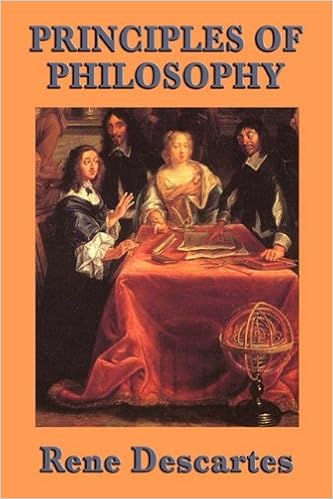 I'd give this five stars, but both editions I've come across, Barnes & Noble and a digital reprint from Amazon, do not contain the whole Principles of Philosophy. Much of the science is missing like a description of Descartes' laws of motion and his vortex theory of planetary motion. This is unfortunate because that is the main reason to read this today, as part of the history of scientific thought. What we get is the entire first book which summarizes the arguments in the Meditations, and moves onto a deeper elaboration of his ontology. This is the most interesting part of the book and is very important to understanding how Descartes relates to the Scholastic tradition.
  Basically, instead of ten categories like Aristotle had, we have three or four depending on how you look at it. There are substances, principle attributes, modes, and maybe accidents. Or substance, quality, quantity, and affection (maybe). Gone are relation, action, passivity, place, time, and position. Using the famous method of doubt, Descartes denies or severely scrutinizes Hylomorphism (that every form has a corresponding material object) by arguing that what we think corresponds to something actually existing could only be a fiction of the mind. Real as thought, but not objectively. Given that, formal reality is different from objective reality. Fire does not have its own form, but has both an ideational content (color, smell, heat) and objective material content (motion in space). Position is just how something is situated among other object. Time is the duration of something in existence, but not something in of itself (without space).
For Aristotle a substance is an individual thing. For Descartes substance is a distinct thing, known conceptually. His new standard for ontology is how doubtable it is as something existing independently. And so substances are designated by innate ideas. What always accompanies my perception of material objects is what reflects their true and distinct nature, which is spatial extension. Whatever I can doubt about the reality of my thoughts, there is always thinking and its modes willing, feeling, affirming, denying. Only those objects of either these two substances, matter and mind, exist.
This was intended to a be a textbook to replace the Aristotelean/Scholastic curriculum in schools. The very way it was written shows. It is written in a fairly subjective way almost without reference to anybody else except the thoughts and musings of the author. Everything in the book is quite parsimonious, following from what is said in the first half of Book I. He even says in Book IV that "there is no phenomenon of nature whose explanation has been omitted in this treatise." A bold claim. I think he is right, if you accept his foundational presuppositions. Overall it reads like a synthesis of Scholastic/Medieval philosophy and materialism. He acknowledges that he "made no use of any principle which was not received and approved by Aristotle." And to today's readers I think he is right. The language he used seems archaic today. Offering a proof of God and talking about substance for instance. He briefly mentions Democritus, mostly to deny more influence from him than anybody else. He was probably talking like this to avoid conflict with Catholicism and avoid charges of atheism because he is in retrospect key to the materialist, mechanistic conception of the universe. Nonetheless I see a synthesis between the old and emerging "corpuscular" or atomistic views of the universe which reigned until around the 20th century.
Tuesday, August 18, 2015
The Categories of Existence: My Ontology Part 2
(Please read part one of my ontology first. Then look at the square at the bottom to understand where I'm leading to)
Now to the categories of what can exist. There are four:
(1) A substance is that being which is self-explanatory. Substance exists independent of anything else, and its nature is contained in itself (all predicates are in the subject). What can be said about it belongs to it alone both clearly and distinctly, although other things may reflect its properties. Substance has the most reality of what exists in its clarity and distinctness. Substance has four distinctions; infinite and finite, and pure and impure.
-An Infinite substance is that which all its modes are defining attributes, which it has a greater number than anything else. An infinite substance's essence entails its existence, for if anything can be known to exist at all it describes the infinite substance.
-A finite substance has a single essence defining attributes, and so only exists objectively if this particular attribute exists (ideationally).
-A pure substance has no parts other than itself as a whole. If broken down into smaller parts it loses its nature. If it can be divided further, it is not pure.
-An impure substance can be divided into smaller parts while retaining its nature.
Infinite substance has more objective reality than finite substance, and pure substance has more clarity than impure substance. An infinite pure substance is more real than a finite pure substance, while a finite pure substance has more reality than an infinite impure substance. There is not a pure, impure, infinite, or finite substance by themselves just as there is nothing which is true ideationally alone (C or p) or objectively alone (N or c).
(2) An attribute is what belongs to a single substance and not another. They are distinct thoughts that are clear in what they represent. These are all innate modes. Also can be called quality, essence or defining mode. There are three attributes; perfection, thought, and extension.
-Perfection. What is called perfect contains everything that can be said about it, and there is nothing else which is like it to be greater or lesser than. The concept of a square having four equal sides or a circle's points all being of equal distance from the origin.
-Thought. Thought is what occurs with everything we do even in the absence of any objects of sense. This includes willing, doubting, judging, affirming, denying etc. Deprived of all senses, if we still think there is something to think about, ourselves, which has an objective existence. Thus we can think of ourselves and only ourselves. The activities which occur in regard to only ourselves and accompany anything we do.
-Extension. What is extended takes up space, in more than one dimension, and can be divided into smaller parts. Whenever we imagine an object, we cannot conceive of it without being extended in space. We can imagine something without color or smell, but not without spatial extension. An extended thing can be divided further and further and be what it is, otherwise it is not extended.
(3) Modes are ideas which themselves exist in regard to something they represent. Modes are intentional thoughts, they are about something. Also called quantity. Some modes however refer to consciousness, thought itself, and are not intentional in the same way. Modes are the different ways a substance can exist in thought, all having reality because they are thought and represent something. There are two kinds of modes; innate modes and caused modes.
-Innate modes are those that are present to consciousness itself regardless of what is thought about, as if they inhere to mind substance. Yet they are not essential to mind substance, and so can belong to other things.
-Caused modes arise from without consciousness and so are not as clear, yet they are intentional and so belong to something objective.
(4) Accidents are ideas prior to any determination, present in thought yet not known to belong to anything outside of thought, even mind substance. Also referred to as affection or being affected. Accidents are neither clear nor distinct. Accidents are not essential to substances and their relation to the powers a substance has is unknown. There are two kinds of accidents; passions and the unconscious.
-A passion is present in thought, yet does not give us a clear idea of what the cause is nor whether it is essential to anything.
-The unconscious refers to a cause of ideas which is not a body or mind as we know them, and yet is not out of consideration. There is no clear notion of what the unconscious is, nor is it necessary to explain what we know. But it is not impossible.
There are three substances which are determined by three attributes (essences, or defining modes) and by whether they are pure, impure, infinite, or finite.
(1) Mind-pure,finite-thought
(2) Body-impure,finite-extension
(3) God-pure,infinite-perfection
There are two kinds of modes
(1) Innate Modes
(2) Caused Modes
And two kinds of accidents
(1) Passions
(2) The Unconscious
All together, we get:
| Clarity | Distinctness |
| Substance | Pure>Impure, Infinite>Finite |
| Attribute ^ | Perfection>Thought>Spatial Extension |
| Mode ^ | Innate>Caused |
| Accident ^ | Passion>unconscious |
We have ten subcategories when we differentiate distinctiveness and clarity to the four general categories, in an ordinal rank.
1) Sfp= Mind Substance. Cc.
2) Sfi= Body Substance. Cc.
3) Sip= God Substance. NC.
4) Ap= Perfection Attribute. NC.
5) At= Thought Attribute. NC.
6) Ae= Extension Attribute. NC.
7) Mi= Innate Mode. Cc.
8) Mc= Caused Mode. Np.
9) Ap= Passions Accident. pc.
10) Au= Unconscious Accident. pc.
All substances are clear. My existence as mind is clear, though it is contingent. The existence of bodies is clear, both empirically and as a concept, yet it could be that there are no bodies, at least as conceived. I can still think and have a mind (exist) without a body as mind is its own substance. God is clear as being infinite, anything which exists describes this being, and God is necessary as nothing else is needed to explain what is said to be God, being perfect.

(The c below N is lowercase c; the C above p is uppercase).
Subscribe to:
Posts (Atom)