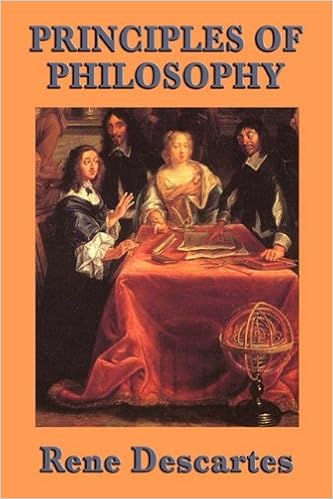
 I'd give this five stars, but both editions I've come across, Barnes & Noble and a digital reprint from Amazon, do not contain the whole Principles of Philosophy. Much of the science is missing like a description of Descartes' laws of motion and his vortex theory of planetary motion. This is unfortunate because that is the main reason to read this today, as part of the history of scientific thought. What we get is the entire first book which summarizes the arguments in the Meditations, and moves onto a deeper elaboration of his ontology. This is the most interesting part of the book and is very important to understanding how Descartes relates to the Scholastic tradition.
  Basically, instead of ten categories like Aristotle had, we have three or four depending on how you look at it. There are substances, principle attributes, modes, and maybe accidents. Or substance, quality, quantity, and affection (maybe). Gone are relation, action, passivity, place, time, and position. Using the famous method of doubt, Descartes denies or severely scrutinizes Hylomorphism (that every form has a corresponding material object) by arguing that what we think corresponds to something actually existing could only be a fiction of the mind. Real as thought, but not objectively. Given that, formal reality is different from objective reality. Fire does not have its own form, but has both an ideational content (color, smell, heat) and objective material content (motion in space). Position is just how something is situated among other object. Time is the duration of something in existence, but not something in of itself (without space).
For Aristotle a substance is an individual thing. For Descartes substance is a distinct thing, known conceptually. His new standard for ontology is how doubtable it is as something existing independently. And so substances are designated by innate ideas. What always accompanies my perception of material objects is what reflects their true and distinct nature, which is spatial extension. Whatever I can doubt about the reality of my thoughts, there is always thinking and its modes willing, feeling, affirming, denying. Only those objects of either these two substances, matter and mind, exist.
This was intended to a be a textbook to replace the Aristotelean/Scholastic curriculum in schools. The very way it was written shows. It is written in a fairly subjective way almost without reference to anybody else except the thoughts and musings of the author. Everything in the book is quite parsimonious, following from what is said in the first half of Book I. He even says in Book IV that "there is no phenomenon of nature whose explanation has been omitted in this treatise." A bold claim. I think he is right, if you accept his foundational presuppositions. Overall it reads like a synthesis of Scholastic/Medieval philosophy and materialism. He acknowledges that he "made no use of any principle which was not received and approved by Aristotle." And to today's readers I think he is right. The language he used seems archaic today. Offering a proof of God and talking about substance for instance. He briefly mentions Democritus, mostly to deny more influence from him than anybody else. He was probably talking like this to avoid conflict with Catholicism and avoid charges of atheism because he is in retrospect key to the materialist, mechanistic conception of the universe. Nonetheless I see a synthesis between the old and emerging "corpuscular" or atomistic views of the universe which reigned until around the 20th century.

No comments:
Post a Comment